
On July 26 (Tuesday), Ongeki celebrated its 4th anniversary!
To commemorate this, we’re bringing you a special edition of the “Ongeki Chart Team Report”!
Staff Message Part 1 can be found here:
We would also appreciate your feedback on the Chart Team Report using the hashtag #音撃譜面部会報.
In addition, for opinions and impressions not limited to this article, as well as feedback regarding SEGA rhythm game charting in general, please use the hashtag #ゲキチュウマイ譜面サポートセンター on Twitter.
Now, please enjoy!
※This article contains detailed spoilers for the event “Memories of O.N.G.E.K.I.”. Please read with this in mind before continuing.
<Monoclock>
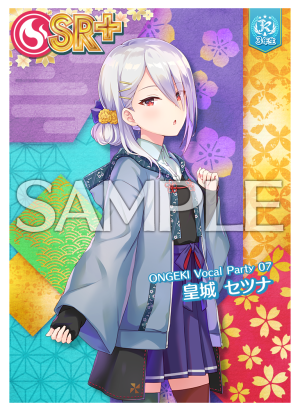
Favorite Card: Setsuna Kōjō[ONGEKI Vocal Party 07]
It’s been a while again, this is Monoclock.
How did you find the “Memory” event, which was developed with the full strength of not only the bright MEMORY chart team but the entire ONGEKI team?
From my own perspective as well, Spring Memory—implemented without any prior announcement on the day bright MEMORY went live—was something unprecedented in SEGA rhythm game history. With no way to predict what would happen, I found myself excited and anxious, wondering when players would discover it, and it became something very special to me.
It was around 10 p.m., I think, when information suddenly spread everywhere. Social media exploded, streams showed players getting hyped in real time, and I even saw comments like, “I went to the arcade, came back, and I’m going again!” Seeing players experience exactly the same feeling I had about 15 years ago—what I consider the best kind of game experience—I ended up drinking alone at home, crying as I watched it unfold. I don’t think I’ll ever taste alcohol that good again.
After that, additional Memory content was released, including boss tracks reminiscent of those from various titles, each with intense difficulty. While reminiscing about those past memories, players continue to take on these challenges…
I would like to offer an apology here.
In the previous chart department report, I wrote the following regarding future direction:
“Since Level 15 has been added, we are not currently considering a direction where Level 14+ or Level 15 charts will be added more frequently than before. (omitted) Unless there is a very strong reason, we do not believe we will be adding them.”
Looking back now, especially given what followed only a few months later, I fully understand how this comes across as unreasonable. I sincerely regret that I wrote it so lightly, which may have reduced trust and further increased concern among users. I sincerely apologize.
This may sound like an excuse, but the reason this happened is that the aforementioned “strong reason” ended up being decided shortly after that report was released. For more details, I would appreciate it if you could refer to Koha D’s message. The entire intent behind Memories of O.N.G.E.K.I. is to express the idea of a “final chapter” in the strongest possible way, and to make what appears here feel like the ultimate endpoint of ONGEKI as a game.
…With that serious talk out of the way, the theme this time is:
“Selecting the best chart from each ONGEKI chart team member, as chosen by the chart quality lead!”
The reason for this is that, while drinking with Amaryllis-kun and Usagi Laundry-kun at one point, I said something like: “It’s possible to theoretically explain fun after stripping away rough edges and optimizing for quality, but I’m so bad at giving honest first-play impressions that I can’t properly praise things from a pure experience standpoint, sorry.” Since then, I’ve always felt bad toward the chart team.
So since I don’t know when I’ll get another chance to talk about ONGEKI charts like this again, I want to go all-in on praising them this time. Just listing things normally would result in a thesis-length document anyway, so I’ll introduce each contributor from the ONGEKI team and highlight one chart per person.
Roche @ Penguin
A genius who creates uniquely original charts at incredible speed—he might as well have been born for chart design. Since the early days of ONGEKI, we’ve talked extensively about charts together, and he has been like a true partner in development.
GEOMETRIC DANCE / MASTER
It perfectly captures the signature difficult sections typical of Yamamoto Maoki’s compositions—such as the opening, pre-chorus, and outro—while making the catchy chorus feel extremely intuitive and satisfying. From a production standpoint, it’s an extremely difficult track to chart, yet he makes it look effortless. When he said things like “let’s recreate the paper airplane part,” I did end up holding my head in my hands, but these kinds of exchanges are part of what makes development fun. I hope he continues to value this boldness going forward.
Techno Kitchen
If Roche is a genius of execution, then Techno Kitchen is a genius of creating “1 from 0” and discovering fun itself. His declaration that “synchronizing TAPs with the player character is fun” is one of the reasons ONGEKI has been able to take its current form so cleanly.
HONEY-Q / EXPERT
A chart that showcases his signature style. While mechanically simple, the real focus is how to present it in a way that feels interesting. It raises the perceived excitement without increasing actual difficulty, serving as a textbook example of ONGEKI’s identity—delivering an experience you cannot get in other rhythm games. As a SEGA title, this philosophy is also important in preventing unnecessary inflation of note density.
Revo @ LC
A backbone of the ONGEKI chart team, who considers matters from many perspectives. He guided me properly even when I was still inexperienced as a quality lead. However, due to his absurd hand speed, he tends to produce charts with extreme physical demands, often leading to feedback like, “Sorry, this is a bit too intense!”
Like the Sun, Like the Moon / MASTER
As many know, it’s famous as one of the best songs in Re:Stage! The flashy presentation is great, but the way the sustained vocals in the chorus sync with lever movements and transitions is incredibly satisfying. It’s the kind of chorus that makes you pick the song just to play it. The ending section’s dual-hold endpoint placements are also very characteristic of Revo’s style.
rioN
A highly structured chart designer who sometimes leans rigid, but consistently delivers charts that clearly express “this is what makes ONGEKI fun.” He also handled much of the early planning work for ONGEKI, making him a true behind-the-scenes pillar.
Kattobi KEIKYU Rider / MASTER
At a time when chart files were usually around 50KB, he submitted one six times larger. The editor struggled to even open it, shocking the entire team. Early ONGEKI charts were often just “drawing with lanes,” and rioN—being the only one with artistic sensibility—helped unlock the game’s potential. Even if TAP visibility is a bit rough, the idea of literally playing a rhythm game while running along lanes is still exciting.
Chart-100
Known to experienced players as someone who creates extremely intense charts. Early on, I personally aimed to “soften” his style into something more accessible, but the result is something you can probably judge for yourself.
He also often accompanies V-related events in private life.
In Chaos / MASTER
A nearly perfect implementation. From the early days, we thought Crankin’ DJ tracks would suit ONGEKI, but actually playing it revealed just how well lever interaction matches the music. The low note count made difficulty rating unusually difficult, but in the end it became a chart fully infused with his identity.
Greenification Committee Chair
A late addition compared to the initial members, but a true hero who helped when there was very little time before launch. His charts are very passion-driven—sometimes impressive on first sight, sometimes difficult to adjust—but that raw energy is a major strength.
High Free Spirits / EXPERT
Even though “Canaria is the best chart!” is often heard, I chose this one because the wall section in the chorus is simply too satisfying. ONGEKI’s wall buttons were truly blessed to exist. Originally we minimized wall usage due to movement constraints, which unintentionally created a strong synergy with the chorus hits. This is easily one of the most “must-play immediately” charts, and I personally played it more often than the MASTER version. It’s a shame it can no longer be played.
Amaryllis
A developer with overwhelming rhythm game knowledge. Though he initially struggled with chart creation, he rapidly improved and contributed a wide variety of approaches. He is also highly proactive in giving feedback after completion and has an almost unfair level of competence.
Shamshir -rough Pt.2- / MASTER
A keyboard-heavy chart that some players may struggle with, but I personally consider it one of the best ONGEKI charts ever created. The way it forces players to decide between lever usage and 6-lane keyboard play is something rarely seen before. The performance feel is exceptional, and the balance of complex patterns is extremely well executed. I still vividly remember telling him, in genuine excitement, “This is really good!”
Usagi Laundry
When I first learned he would join, I thought, “What could I possibly teach this guy?”—but after some guidance, he eventually became sub–quality lead level. He also became deeply knowledgeable about V-related topics. A true hero who helped stabilize ONGEKI PLUS during its difficult period.
Ne! Ko! / MASTER
Everyone’s favorite Ne! Ko!. It may well represent ONGEKI PLUS itself. Structurally, it often resembles Roche’s style, but the way lane density builds excitement across the field is extremely satisfying. His LUNA version also shows his rhythm game skill at full strength, and I often find myself adjusting his bold variations while admiring them.
Miso Katsu Samurai
The first user-origin hire in the ONGEKI team. He has a strong core, though initially struggled balancing user perspective with developer perspective. Now he has become one of the fastest chart creators, capable of producing near-final drafts with minimal adjustment—an elite ONGEKI player.
Fog Library / MASTER
This chart reflects his evolution from a period of heavy keyboard-focused designs to a more balanced understanding of what players currently need. It is a difficult “brain-training” style chart, but one that encourages engagement rather than rejection. The gimmicks are well-balanced, and the thematic cohesion with the song is excellent.
Monoclock (myself)
Finally, myself.
From bright through bright MEMORY, I went through a period that could only be described as a slump in chart creation. However, seeing everyone surpass me and continuously produce outstanding charts helped me accept my current capabilities and appreciate the strength of the team.
I will introduce three charts that are especially meaningful to me.
YO-KAI Disco
Since around 2008, I’ve been playing STG titles and encountered many songs through them. Among them, Yousuke Yasui’s compositions felt truly genius—blending FM synthesis with modern sound design and STG aesthetics in a way that constantly excited and sometimes moved me to tears. To me, he is almost a divine presence, especially with FM bass lines that hit perfectly.
While I always wanted to include his music, it was difficult due to structure and audience fit. However, with ONGEKI’s gameplay system and a suitable charting approach, we were finally able to implement it. I am deeply grateful.
The concept was a two-loop structure: the first loop is closer to a standard MASTER rhythm-game style, while the second loop shifts dramatically toward bullet-hell style and original references. I originally wanted to recreate branching fields from the source game, but it was not technically possible. I still tried to evoke the atmosphere of a dungeon entrance through field manipulation.
For the chorus, I fully expressed my long-standing desire to “hit” those sounds in a rhythm game. It is honestly an incredible chorus.
Ongeki / Chaos
First, congratulations to everyone who cleared it.
Frankly, I did not expect such a high clear rate and have been surprised watching player progression. I myself am still unable to clear it because I am genuinely bad at dodging bullets. If anything, those who can clear it likely have top-tier STG skill—so I encourage trying arcade STGs as well.
Jokes aside, this chart was extremely difficult to create.
Unlike previous works with clear motifs, there was no established reference for what constituted enjoyable or fair bullet patterns. For example, the “caterpillar” phase alone took over 10 hours to design just a few measures (though placing bullets takes only minutes).
The constraints of ONGEKI’s system made things even harder: slow travel time for aimed shots, limited variation for fixed patterns, and restricted placement lines all made expressive bullet design extremely difficult. I repeatedly doubted my own ability and struggled mentally during production.
Still, I worked step by step to balance difficulty curves and ensure clarity—making each pattern recognizable enough to have a name. The reverse-direction section is one of my personal favorites.
In the end, seeing it reach number one in selection rankings felt like validation of everything I had worked for. I am deeply grateful to everyone who played it.
I also contributed heavily to the music direction. I wanted STG fans to notice details—such as the use of composer pseudonyms and the opening voice line “GET DOWN EVERYBODY!” by Mitsuyoshi-san. These are fairly niche references, and if you caught them, that’s impressive. I am very thankful to composer Shinji Hosoe for accommodating these requests, and also apologize to Mitsuyoshi-san for multiple retakes of the voice recordings.
Island Breeze / EXPERT
Modern rhythm games tend to favor high BPM songs (160–170+), which naturally leads to lower BPM tracks (130–140) being selected less often. As a result, song diversity becomes narrower, especially compared to earlier rhythm game eras.
One of the core purposes of rhythm games is to let players experience a wide range of music genres, which is part of their appeal. Personally, I felt it was unfortunate that low-BPM tracks were being sidelined due to popularity and commercial trends.
So from a developer position, I decided to do what I could: create “god-tier” charts for low-BPM songs to demonstrate their appeal and hopefully increase appreciation for them.
This particular track was one of the most impactful songs I’ve encountered in the past decade. I intended to create something so strong it could even rival MASTER difficulty itself.
Of course, as a quality lead, this is not necessarily the most “proper” stance—but that’s how I felt.
As for the chart itself, I believe it speaks for itself. The imagery that comes to mind is everything.
I once had a personal frustration that I could never surpass my third CHUNITHM chart, “Trismegistus.” I now feel I have finally overcome that barrier. This is the strongest ONGEKI chart I have ever created.
Please try it in an arcade.
I was originally told, “You’re good at STG, so you’re on the ONGEKI team now,” and thrown into the role with no real experience about five years ago. Since then, I’ve gradually become one of the most senior members.
What I gained during these five years—through struggle and persistence—has reshaped my perspective on both game design and life itself.
If ONGEKI has given players even a small memory, lesson, or experience that felt new or meaningful, then as a developer and as a rhythm game player, nothing would make me happier.
Even as ONGEKI continues to evolve in form, I hope players will keep finding enjoyment and motivation in it. As long as that continues, the ONGEKI team will continue to respond with everything we can give.
I sincerely hope ONGEKI, this best of games, continues for a very long time.
<Ichinose Rizu>
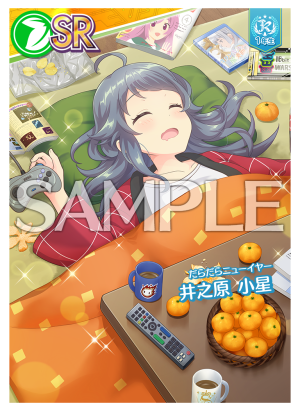
Featured card: Koboshi Inohara[Lazy New Year]
Hey there, Ichinose Rizu here.
This time I’m going to talk about the existence known as Ichinose Rizu. Thanks for tuning in.
● Behind-the-scenes revelations
Did the foreshadowing in Alea jacta est! and the sudden change of the existing name to “monoclock” surprise you?
To be honest, this “reveal” was already something I had planned since the ONGEKI PLUS era.
Within Monoclock (the chart director), it was treated as a kind of internal challenge: whether this fictional identity could be maintained all the way until the final installment without ever being exposed.
So in other words, the fact that it was revealed means the ONGEKI series itself has reached a kind of “milestone” or turning point.
I’ve made it sound like this whole fictional-name operation was intentional from the start, but the actual trigger was very simple:
I didn’t want to get scolded for the Arisa theme charts.
That’s it. Obviously. Nobody enjoys walking straight into getting yelled at.
From there, I referenced the kind of “imaginary friend” narrative games I liked at the time and created the fictional persona “Ichinose Rizu.”
I made sure it was completely detached from the Monoclock name, gave it a loosely character-like, memorable vibe, and used it as a way to experiment freely with chart design.
And then, in the final installment, the existence known as “Ichinose Rizu” would suddenly be erased.
The hope was that, for anyone who had even slightly grown fond of or curious about “Ichinose Rizu,” it might leave a small emotional impact.
That was the idea, at least.
However, running Ichinose Rizu turned out to be much harder than expected:
- I had to ensure a proper number of charts as if it were a real individual identity
- I had to establish what makes “Ichinose Rizu” distinct
- For these kinds of chart-team reports, I had to effectively write double the content
- During the Chart Boys tournament, I somehow ended up having to play “Headshot Mirror,” a mode I had never even touched before
(For the second “Eta-Beta-Eta,” I was at a V-related event that day, so Mizokatsu-sensei kindly played it for me!)
Especially the first two points were really tough.
Given that the Arisa theme had already given me the impression of being “that dangerous guy,” I had no choice but to fully lean into that direction.
Meanwhile, I kept Monoclock relatively low-profile while still maintaining a normal output of charts.
On the Ichinose Rizu side, I intentionally created opportunities to showcase layouts that ONGEKI could technically do but rarely places because they’re too difficult, and I pushed forward chart experimentation with a “I’ll take all the blame for the chart team” kind of mindset.
Honestly, this was really hard work, so I want people to properly acknowledge it. Praise me.
In the end, the reveal happened in bright MEMORY, and I was genuinely happy that players reacted with things like “Wait, we had no idea!” and got excited about it.
● About the charts themselves
I usually avoided talking about my own charts, but since I probably won’t get another chance, I’ll mention a few of my favorites.
【BOUNCE & DANCE】 and 【Kokoro】
These two were originally planned with their names reversed—“Kokoro” was supposed to be an Ichinose Rizu chart.
That’s why Kokoro ended up a bit chaotic; that’s a leftover trace of that plan. Sorry about that.
On the other hand, BOUNCE is basically a Monoclock-style chart built around low-speed vertical jacks as a personal preference, so it slightly drifts away from the Ichinose Rizu concept.
However, after the “Arisa theme chaos,” it kind of worked as a contrast, so the separation between names may have become less noticeable.
As a side note, the reason I changed the naming was simply because Revo said,
“Wait, Kokoro isn’t Monoclock?”
That’s literally it.
【SILENT BLUE】
This is one I’m pretty proud of. Even now, the lane design and HOLD movement still feel stylish.
It’s probably in my top 3 charts I’ve ever made in ONGEKI.
Originally, it wasn’t supposed to become that recognition-heavy; I was aiming for something around level 13+.
But the final chorus’s blue HOLD progression ended up looking like it would become much harder than expected.
So I kept going back and forth in my head—should I tone it down or not?—and that internal struggle ended up reflected in the final identity.
And in the end, it turned into “Monoclock vs monoclock” after the reveal, which is honestly just kind of embarrassing.
【Burning Steel Inferno】
Since it’s a “Wonder” game, I made a “Wonder”-style chart by floating a lot of wall buttons in midair.
I had only played the game a handful of times at that point, so I relied on basic understanding and tips about enemy placements from planner T.
Thanks to that, I think I managed to capture the feel quite well. Really grateful to T.
Apparently, during the final wall-button section, some people even applauded the chart’s execution, which made me really happy.
【Magical Panic Adventure】
This was designed as a kind of culmination of everything Ichinose Rizu represented so far, and I genuinely enjoyed making it from start to finish. Being able to freely design charts is wonderful.
The conceptual references included things like:
Arisa theme → BOUNCE-style HOLD gimmicks → HOLD route puzzle → Burning Steel Inferno → 7th Sense → high-density TAP with rearrangeable patterns → forbidden simultaneous upper-lower mash → enhanced Arisa theme
It’s a chaotic chart where both the music genre and chart style constantly shift, and I think that unpredictability worked really well.
Also, the low combo count was intentional. Previous boss songs tended to have high combo counts, and that was part of a “reason,” if you know what I mean.
● Going forward
Even though the name has been revealed, there are no plans to stop using it.
If I make something that feels like “this is crazy” or “I really pulled this off,” I’ll continue releasing it under Ichinose Rizu.
After all, using this name makes people brace themselves in advance.
Getting hit while unprepared feels worse than getting hit while ready, right? That’s the idea.
Since I kind of exhausted everything in bright MEMORY, it may be harder to introduce brand-new concepts going forward, but I’ll keep doing my best in moderation.
I also want to be more active in releasing charts for maimai and CHUNITHM.
If I manage to create something good, I hope you look forward to it. Expect some strong charts.
<Revo@LC>
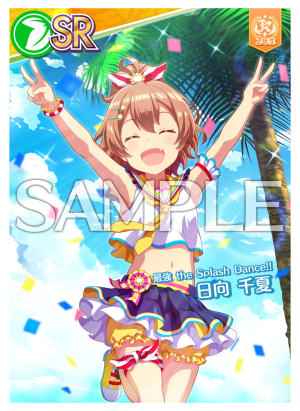
Favorite card: Hinata Chinatsu [Strongest the Splash Dance!!]
Congratulations on the 4th anniversary of ONGEKI! This is Revo@LC.
I was torn between Hinata Chinatsu [Wanna Come In?] and this one, but I ended up choosing this because I couldn’t resist the charm of those slightly protruding canine teeth.
Here, I’d like to talk about the charts I’ve created. As always, it would make me very happy if I was able to move even a small part of the emotions of those who played them.
【Transcend Lights】
This is the signature track of ONGEKI bright.
To match the world view of the version, we commissioned a composer who felt like the only possible choice for it. They delivered something that matched the image perfectly from the very first draft, but I remember asking them to slightly increase the BPM so it would work better as a rhythm game track.
The main focus was showcasing the new feature at the time, the “Colorful Lane.” On a deeper level, there was also a secondary goal: to let players experience the expanded field system that had been introduced at KoP 2020, not only in high-difficulty content but in more accessible play as well.
【Hide & Attack】 (LUNATIC)
As many of you know, this is a track from the best idol unit.
I started making this chart from the idea of “if you can hit the drums cleanly at the end, everything is good.” Since it’s a high-energy track, the goal was to make a chart where you can comfortably enjoy dense note patterns. For the chorus, I wanted to preserve a steady quarter-note groove, so I added cross-hand motion and mixed rhythms with the melody to give it a Re:Master-like feel.
【Chanoir】
As many of you know, this is also a track from the best idol unit.
At the Lapis Re:LiGHTs live performances, the AR staging left a strong impression on me, so I tried to incorporate that feeling into the chart. There are also sections that reflect choreography here and there. My first draft had too much color information and was criticized quite harshly by Monoclock-kun for being too visually noisy, so I revised it.
This isn’t limited to this song, but ONGEKI already has a very high amount of visual information on screen, so balancing that information is often more important than raw keyboard difficulty.
【Like the Sun, Like the Moon】
As many of you know, this is also a track from the best idol unit.
I’ve always been impressed by Stellamaris’s overwhelming performance ability. At first glance it seems easy to chart, but once you actually try, the chorus becomes surprisingly difficult. If you only follow the vocals, it feels stretched out; if you try to capture the call-and-response as well, it feels like you need three hands. I had to carefully think through how to land it in a way that still felt natural.
【Wagamama MIRROR HEART】
This is a song I liked so much that I insisted—selfishly—that it be included.
I also think it fits rhythm games extremely well. When I just followed my instincts while building it, I received approval from the quality lead without any comments or corrections, which might have been the first time that ever happened. In the outro section, there is a “contrarian” pattern placed intentionally.
【Farewell Waltz】 (LUNATIC)
A piece that almost everyone has heard at some point.
Since this was an April Fools’ concept, I spent a long time thinking about how to express the joke element. I had always wanted to try the idea of moving through an extremely thin playfield, so I finally used it here.
I even prepared a trick using black Colorful Lanes to make it look like a thin field while actually having no field at all—but Monoclock-kun immediately shut that down, so I abandoned it (laughs).
I also drew on memories from when I made a CHUNITHM WE chart called “Title,” letting the word “closed” slowly fall down the screen. In the final section, the xylophone-like passage across four lanes is meant to feel like you’re actually playing a xylophone—try alternating both hands across left and right keys while crossing the lever.
【Super Forward! Perfect Smile!】
A perfect maximum-energy song that really captures Chinatsu’s personality.
It originally ended up leaning toward something like a very strong level 14 chart due to sheer momentum, so I refined it repeatedly until it reached its current form.
Due to scheduling constraints, the vocal recording was extremely last-minute. I actually built the chart using a temporary vocal track first, then quickly replaced it with the final recording and released it immediately afterward.
【Illumination】
This is a game implementation from Yuki’s CD in the goods campaign.
It’s a song I absolutely love, but the chorus accent is almost entirely off-beat, which made it difficult to translate into chart form.
There are various interpretations of who the “you” in the song refers to, but when ordering the song, we did specify who Saki is singing to.
The distinctive “…?” sound in the line “Hey, won’t you look too?” during the outro was an improvised direction during recording, which really highlights the composer’s skill.
◆Summary
The world has been filled with many dark news stories, but we developed and operated ONGEKI bright through bright MEMORY with the hope that its brilliance could illuminate even a small part of everyone’s lives. How was it for you?
If even one “memory” of ONGEKI has been engraved in your heart, then nothing would make us happier as developers.
ONGEKI as a rhythm game will continue going forward, and with your continued support, we believe we can meet even more expectations.
We sincerely hope you will continue to visit arcades while taking proper precautions, and keep enjoying ONGEKI—a truly special game—for a long time to come.
<Greenery Committee Chair>
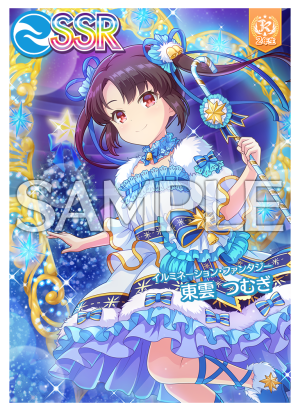
Favorite card: Tsumugi Shinonome [Illumination Fantasy]
4th anniversary!
So this time as well, I’ll share a few behind-the-scenes stories.
■ Song selection anecdotes
• Around the time of ONGEKI bright, we asked members of the “Ongeki Chart Team” to nominate one track they personally really wanted to include, restricted to the VARIETY category.
The results were as follows:
Revo@LC → Electric Emotion
Monochrome Clock → Epiturika no Matsuri
Greenery Committee Chair → rePrayer
Amaryllis → Shamshir -rough Pt.2-
Usagi Laundry → Akasagarbha -reincarnate-
Miso Katsu Samurai → MANIERA REMASTERED
It’s a very eclectic, à la carte selection that really reflects everyone’s tastes.
In the end, everything was actually implemented.
As for what happened afterward, I assume everyone involved has already spoken about it, so I’ll leave it out here.
• When adding Project DIVA module cards, we asked people in the chart team with especially strong attachment to DIVA to nominate one DIVA song they personally wanted included.
The results were:
Monochrome Clock → So much loving you★ -DIVA Edit-
Roche @ Penguin → Saihate
Miso Katsu Samurai → Miracle Paint
Usagi Laundry → Paradichlorobenzene
In fact, this was all from the second round of requests.
In the first round, everyone generously suggested many great songs, which I’m very grateful for, but the selections ended up overly concentrated on hidden gems that would be difficult to chart in ONGEKI. So we ran a second round, which resulted in a much more balanced set of picks that were ultimately adopted.
■ About chart design
○ Shamshir -rough Pt.2- (BASIC)
This is the chart that broke the previous record for “hardest BASIC chart to create” that I mentioned last time.
The BPM is so fast that placing notes in quarter-note rhythm is difficult.
It’s impossible to maintain a consistent rhythmic grid for note placement.
Even trying to anchor notes at bar starts doesn’t work, because the time signature changes almost every measure.
Once you start letting bells or bullets carry the rhythm instead of taps, the chart ends up locked into that approach.
I focused entirely on shaping it into something that still feels like a BASIC chart while following the piano line, but in order to keep it playable in terms of required note density, the rhythm difficulty became so extreme that it ended up as a rare Level 6.
There are only a few boss-level BASIC charts above Level 6, but excluding “Recollect Lines,” which is not really designed as BASIC in the traditional sense, I believe this is probably the hardest due to sheer rhythmic complexity.
Please give it a try. It allows up to 6 BREAKs for SSS+.
○ 2112410403927243233368 (BASIC)
There is actually a section where it violates the charting regulations. Try finding it.
○ μ3 (BASIC)
This was created with the intention of making a “boss-level BASIC chart.”
As a result, I allowed some ADVANCED-level rules in limited form (such as “sushi” patterns and moving bullets).
That said, the BPM isn’t extremely fast, so it ends up being a fairly straightforward dense 8th-note-heavy chart.
It can serve as a stepping stone toward ADVANCED charts.
○ Recollect Lines (BASIC)
This was created using ADVANCED charting rules, essentially making it an ADVANCED chart in everything except its difficulty label.
There were too many constraints to properly build it as a BASIC chart, and it was difficult to represent the intended difficulty for this boss track otherwise.
Additionally, because the surrounding difficulty curve spikes significantly, we needed something substantial here to avoid a gap in the progression. So it was designed with something closer to early EXPERT-level intent.
I’m not entirely sure if that worked as intended…
But at least I’m satisfied that I was able to make a BASIC (effectively ADVANCED) chart that fully captures the sounds I wanted.
○ Titania (EXPERT) / Op.I《fear-TITΛN-》 (EXPERT)
A brief note on the red charts.
When I first joined, I heard there was a xi boss track, and since MASTER was a collaboration, I jumped straight into EXPERT.
At the time, EXPERT charts that required both hands to handle keyboard-style patterns were extremely rare, so for a Level 13 chart I focused on placing patterns that naturally encouraged two-handed play.
A few years later, Op.I was created using almost the same EXPERT charting philosophy from that era.
The referenced section in Opfer (EXPERT) is about 40 BPM faster, making it significantly more challenging. It really shows how difficulty was sometimes increased by lever mechanics back then.
I aimed for a “modern interpretation of early charts,” though it may have ended up a bit too rich in flavor.
○ Jeanne d’Arc’s Lament (EXPERT)
I specifically wanted to include 16th-note patterns at BPM 220 even in EXPERT difficulty. So wherever 16ths appear, I made sure to carefully structure the lanes.
In high-difficulty EXPERT charts, I tend to prioritize clearly expressing distinctive musical phrases. That includes bells and bullets, but I try to capture as much as possible with taps.
The final section was specifically designed to combine heartbeat-like sounds with bullet patterns.
○ Diamond Dust / Diamond Dust -crystal piano Arr.- (EXPERT)
For the original version, I started with the intention of “making sure every guitar phrase in the middle is played.” As a result, aside from the final ultra dense mixed section, the chart is almost on par with MASTER in terms of note coverage, adjusted mainly through visual design and slight reduction.
For the remix, I used the approach of reusing many field and line elements while differentiating through how the sound is interpreted.
Both are works I’m quite proud of within EXPERT difficulty.
○ Don’t Fight The Music (EXPERT)
Interestingly, over the past year, the EXPERT chart has been played more than MASTER. That’s extremely unusual in rhythm games in general, so I was honestly surprised.
When I originally designed it, I didn’t expect such a broad player base, so it was built as a “full ONGEKI mastery” chart: heavy dual-hand three-lane patterns, frequent switching between left- and right-hand taps within lanes, challenging bell management, and bullet avoidance.
Because of that, players pushing themselves may have found it quite harsh.
However, once you can handle this chart, you’ll likely be able to handle a large portion of ONGEKI content, so I hope those who can clear it will try other songs as well.
○ rePrayer
As mentioned earlier, this was one of the songs I absolutely had to include.
I remember looping it endlessly during my commute.
It has a strong impression of symmetrical patterning, which I used as a core concept in the chorus.
The ending, which some praised as “extremely old-school,” is also worth paying attention to.
Piano phrases like this are irresistible to long-time rhythm game players.
I started playing key-based rhythm games about 15 years ago, so within the team I’m relatively new.
○ Happi Nyuu Nyaa
Best ever.
One of the defining anime songs of the 2010s—no matter what anyone says. I listened to it 108 times in a row.
I kept insisting for four years that I wanted it included for a New Year release, and I apologize to everyone I bothered along the way.
I believe this song is built on an exquisite balance of all its elements, so the chart was also designed around controlled “gaps,” and placements that are easier when played with both hands even without forced guidance.
I tried to respect the intent and artistic structure of the song as much as possible in the chart.
If you understand it, go watch the anime DVDs and check the Nekoneko videos.
If you immediately recognized the referenced chart in “Maarui Sekai,” congratulations—you pass the first round of the Sakasaka Ongeki quiz. Next is the written test on the plane.
○ Let Me Know (feat. Masayoshi Iimori)
The sound is incredible. I chose this track because I wanted more ONGEKI / CHUNITHM / maimai players to experience Masayoshi Iimori’s production style.
In the request sheet, it simply said “technical,” so I made something technical.
The solution was to include configurations that normally get instantly rejected, such as crossing walls while operating the lever and buttons with the opposite hand, and extending those ideas throughout the entire chart.
This is a classic rhythm game design approach—solving constraints by generalizing a single gimmick across the full chart.
I’m confident this is more fun when played as intended step-by-step, so please try it.
○ We Play the Seasons!!
I see this kind of song as having a very specific role, so I shaped the chart accordingly. I’m looking forward to what happens in December. You’re going to play it, right?
○ Say “Jump on the count of three!”
I’ll never forget the Omiya Sonic City Main Hall.
The energy when the intro started. The collective jumping during the chorus. The energy when the second verse began. I remember it all vividly.
It was my first Re:STAGE live, and it left a huge impact on me.
The chart is structurally close to Canaria, packing in “this guitar is insane!” and “this drum part is insane!” moments throughout. There are also many “this bass is insane!” moments, though those are harder to represent in this game, so only a few are included.
This song must be passed down as a legendary character song of the Reiwa era, so I ask for everyone’s cooperation.
○ HEAVEN’S RAVE
At first I tried to incorporate elements from LEGEND charts beyond the opening, but it became too difficult and I had to abandon that idea.
As a mid-tempo track, making it feel like a boss chart required surprisingly technical structure.
I focused on selecting and emphasizing “aggressive sounds” as much as possible. Like the previous “Say Jump,” the goal was to strongly highlight the music itself. If you push that too far, Monochrome Clock-senpai will tell you you’re overdoing it.
After playing this, I recommend also trying Summer Shadow.
Slightly unrelated, but Lake Kawaguchi was amazing—please go there too. Seriously.
○ FREEDOM DiVE
I’ve been a huge xi fan since Happy Dreams (it’s already been 15 years!). The first time a song ever made me cry was the long version of FREEDOM DiVE from the album Parousia.
When it was added to CHUNITHM, I remember dropping everything and lining up at the arcade at 7 a.m. on release day.
For ONGEKI, I was told we could go up to around top-tier Level 14+ difficulty, so I initially filled it with dense 16th notes. However, even standard alternating 16ths were too long to fit within 14+, so extensive adjustments were needed. At first, there were fully packed 16th runs everywhere between segmented 8th-note sections and 3-note 16th bursts.
The cross-hand alternating patterns in the break section may be the culmination of center-cross research dating back to Here We Go in the original game.
I aimed to let players fully experience BPM 222.22 16th-note patterns in all their forms, and I hope they enjoy it.
○ Knocking Harder
I love heavy bass and big kicks, so of course I’m a huge HARDSTYLE fan.
This chart contains all the essence of previous HARDSTYLE charts. I particularly enjoy separating note types clearly by kick/clap/synth because I love mixed rhythms. This song was especially rewarding to work on.
I also translated the feeling of me headbanging into field design. It’s rare that what I personally felt while listening can be almost directly reflected in the chart, so I hope that sense of alignment comes through.
○ Departure
Just amazing.
It’s incredibly fun to fully realize a duet song as a duet chart.
Incorporating elements from past Battle Girl charts also worked well, and this came together very smoothly compared to recent work.
I’m very grateful for the materials provided, including vocal splitting for Sorairo Memories and this song.
With this momentum, can we please include all f*f songs?
○ Marble Blue.
I handled the first half (up to 105 seconds), while Usagi Laundry handled the second half, adjustments, and visual elements.
We made sure to leave space where needed, while also creating clear highlights in the first half leading into the “summer memories” section.
Personally, I finally got to place a “long-considered but previously impossible due to level constraints” pattern I had in mind since the early days of the game, which was very satisfying.
We shared the same intent of making it a strong keyboard-focused chart, so after that it was mainly fine-tuning the hardest sections. Thank you for the artwork as well.
I hope players can relive the “ONGEKI summer” experience through both the song and the chart.
○ Zeelen Wanderung
Too cool.
With the idea that key moments in the song should become key moments in the chart, I structured it very clearly around highlights.
I may have overdone violin-inspired patterns due to getting too excited about wanting to “play the violin!”—some parts may even resemble earlier works like Kokoro. No solo hand trills, though.
The chorus follows a structure of placing flicks first, then holds, then taps aligned to bass, then building the field.
This reflects my general charting approach: decide character placement → place taps → build the field.
A possible method worth considering.
○ Flower
A very powerful song—I’m really looking forward to seeing it performed live.
I felt a strong connection between this song and another track, which I reflected in the chorus charting.
I also see thematic similarities with Starring Stars, so the structure outside the chorus is intentionally similar.
I hope the chart conveys the straightforward strength of ASTERISM.
○ HEADLINER
I’ve followed Hidekazu Tanaka’s work for many years, and I never expected to be involved with something like this.
Please try all versions of the charts I made (BASIC/MASTER) and the ADVANCED/EXPERT charts made by Miso Katsu Samurai. That’s all I really want to say.
Let’s keep singing anytime!
■ About the event
For the event “Memories of O.N.G.E.K.I.” I also helped a bit on the scenario side. Others have likely already written about it, and I share the same feelings.
I also worked on various elements of the “bright MEMORY Appreciation Festival.” Everything was designed while considering how best to communicate with players on the day this article would be released (though I did not write the in-game text itself).
I hope you’ll experience it yourself in the arcade cabinet.
On a personal note, by the time this is published, I will no longer primarily be working on the rhythm game team, but on another team.
I will still be involved in tournaments, but my appearances in chart creation (beyond already-completed work) will likely decrease significantly. I may occasionally return if there is a song I am absolutely determined to work on despite the barriers.
All my gratitude has been poured into the charts I’ve made so far.
I hope you continue to play ONGEKI whenever you visit an arcade.
If you have friends who don’t know ONGEKI, please introduce it to them.
If you find someone online who might be interested, please reach out to them.
In this era, everyone can record and share things.
At the same time, it has also become harder to leave lasting impressions.
I intend to continue doing my part both as someone who leaves records and someone who passes things on.
<Amaryllis>
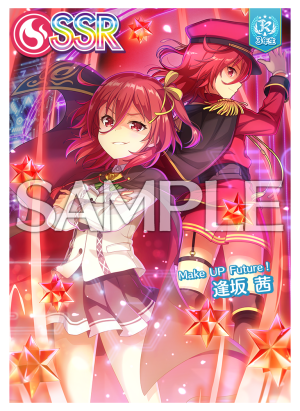
Favorite card: Akane Osaki [Make UP Future!]
Hello everyone, Ongeki players. This is Amaryllis.
In Ongeki bright MEMORY, together with all of you players, we were able to bring the large finale known as Memories of O.N.G.E.K.I. to a close.
I was heavily involved in deciding what cards and songs to include in each chapter to build excitement, and I also worked closely with programmers and designers who implemented everything. It was a project I truly ran around to create, so I’m very happy that we were able to reach the 4th anniversary in such an amazing, exciting state.
This time, I’d like to talk about the charts from Ongeki bright MEMORY that left the strongest impression on me personally.
As you probably know, there can be more than one “number one,” so please bear with me for a while.
◆ Ebbi Birthday (MASTER)
This is one of my absolute favorite songs in Ongeki.
When we were discussing what collaboration to do in Ongeki bright, I casually said, as if it meant nothing, “Maybe Natori Sana would be a good choice?”
A few months later, the collaboration had actually been decided, while I was still pretending it was unrelated and continuing with other work.
Then it came time to create the titles and cards for the collab. On the inside I was shaking with excitement at the thought of working on a collaboration involving someone I admire, but I kept acting like it was nothing. The classic “trying to stay composed” otaku behavior.
After the song was released, Natori Sana introduced the collaboration on her stream. It was the first time someone had praised a chart I made so carefully and in such detail, and I was watching while my pent-up otaku emotions completely exploded.
While introducing the chart, she said something like, “The person who made the Ongeki chart definitely likes Natori,” and she was absolutely right—I’m such a fan that I even watch all her members-only streams.
While working on this collaboration, my guiding thought was not just to make Ongeki players or new “sensei” who would try Ongeki for the first time happy, but also to make Natori herself enjoy it.
At the time, I didn’t yet know there would be a collaboration video where she would actually play Ongeki, but I was confident she would probably see it through searches anyway.
I also hid a lot of small details—like card skills and opponent levels—and she noticed them, which made all the effort feel worth it.
I feel like I’ve gone on too long without actually talking about the chart, so I’ll finally get to it.
“Ebbi Birthday” is a bright, upbeat song, and since it could easily be the first song new collaboration players would try, I focused on making a very careful and approachable chart layout.
I avoided all the usual niche gimmicks or surprising placements I might normally include, and instead aimed to make a chart that lets players experience the fun of Ongeki MASTER charts in a straightforward way.
On top of that standard structure, I layered in lively Sana-chan characters and motifs matching the song, aiming to create a chart that lets you enjoy the whole “friendly internet world.”
Many sensei players probably cried during the call-and-response and the drop chorus, remembering the long-awaited realization of “Sana no Bakutan.” I was also crying while making the chart.
Chart creation involves repeatedly replaying sections for verification, which tends to dull the initial emotional impact of a song—but no matter how many times I listened, the drop chorus still made me tear up.
Despite drawing so many Sana-chan illustrations with all that emotion, the chart was completed at record-breaking speed—probably because I never hesitated and just committed fully.
Whether you know Natori Sana or not, I hope you’ll give it a try.
◆ Catch Me If You Can (MASTER)
This is one of the very best songs in Ongeki.
There was a lot of expectation from the team for this chart, so I felt quite a bit of pressure.
The challenge was how to keep the repetitive chorus and complex rhythmic drop—arguably the core of the song—engaging without making it boring. I tried many different approaches.
Because the song structure is relatively simple, I didn’t want a straightforward 6-lane “falling straight down” chart, so it ended up with some slightly tricky sections.
A niche detail: the lane and field placement at the beginning of this song is exactly the same as Saika’s solo song “What Color… (MASTER).”
If you thought the slightly left-shifted field and the three-color lane appearing just before the field looked familiar, you are an Ongeki expert.
In Ongeki, lanes and fields often appear before notes do, and I think of this as part of the chart’s identity—like a “breath” before the vocals begin.
To digress a bit, in “Solar System Disco,” even though it’s a Vocaloid song, there’s an actual breath before the vocals start, which really shows the composer’s attention to detail.
I still remember enjoying representing that opening breath in the chart more than anything else.
It’s a really great song, so please play it a lot.
◆ Adachi OUFwwww (MASTER)
One of the coolest songs in Ongeki.
I am a huge fan of Akira Yamaoka, and every time I listen to his music I deeply feel, “this is what ‘cool’ means.”
Even though it’s cool, it’s also full of joke elements as you can tell from the title, so I wanted the chart to be sharp and impactful, built mainly around eighth notes, especially in the final section.
Because Ongeki charts tend to have strong individuality, there aren’t many broadly useful “practice charts,” so whenever possible I try to create something like “a practice chart that feels like it should have existed but didn’t.”
The final simultaneous-hit rush in this chart can of course be brute-forced with full presses, but I think actually reading and hitting it properly is good training for recognition.
By the way, the sections where you don’t need to hold the lever are marked by wall-button fields on purpose—it’s a subtle clue. Did you notice?
◆ Shamshir -rough Pt.2- (MASTER)
One of the most challenging charts I’ve ever worked on.
I was the one who originally suggested adding this song. I’m a fan of mommy’s music, and I recommended it because it has both catchy coolness and potential for an unusual chart.
Ongeki charts that are built on continuous 16th-note phrases (in this case, 8th notes at BPM 294…) are already difficult to design, and this being a piano solo made it even harder.
At the same time, I treated it as both a challenge for myself and for the players.
If you make a full-length piano-focused chart in Ongeki, it can easily become a flat, repetitive stream of notes, and you also lose the movement-based identity of Ongeki charts.
Compared to maimai or CHUNITHM, Ongeki has smaller physical movement, so overly uniform visuals can make that limitation more noticeable.
So the challenge was how to preserve the piano solo feel while still making it feel like an Ongeki chart.
I ended up setting two rules:
- Gradually expand from 3 lanes to 6 lanes at the intro, then keep mostly straight lanes until they gradually shrink again in the outro
- Do not use wall buttons
Once I settled on that concept, the chart surprisingly came together smoothly, resulting in what became this rather extreme piece.
It’s not fast, but it’s also not slow enough to relax into each note, and since there are few holds, breaking notes become a major obstacle for higher ranks.
I hope you try it as training for finger independence.
◆ Positive☆Dance Time (MASTER)
One of the most fun songs in Ongeki.
When making this chart, I was thinking: “Are recent Ongeki charts getting too complicated?”
While flashy gimmicks are great, I worried that they might feel heavy for newer players or those returning after a break.
Depending on the song, complex or simple charts are appropriate, but for pop/anime/niconico songs I felt simpler might be better.
At the time, Memory Chapter charts were especially dense and difficult, so I intentionally aimed for something simpler—like a palate cleanser.
However, making it too simple would risk removing all identity, so I had to carefully design themes and presentation that wouldn’t increase difficulty.
I ended up thinking: what makes Ongeki interesting?
One answer seemed to be “repeated same-color 8th-note streams.”
Interestingly, I’m actually not good at continuous 8th-note streams and tend to stop properly reading them.
(Thanks to that, I struggle badly with CHUNITHM’s “Rittai Jouei Torimonocho.”)
But in Ongeki, even same-color streams don’t have to be straight, and repetition can be made interesting through lane and field presentation.
So I created a chart that uses three-color same-color lanes to preview which button to press next, combining readability assistance with Ongeki’s rhythmic fun.
Perhaps because of that careful design, it became the first chart I ever completed with zero revisions—the first draft was the final version.
Some highly experienced players might find it too simple, but I hope you can enjoy it as a return to basics.
◆ Island Breeze (MASTER)
One of the most stylish songs in Ongeki.
Given the tempo of Palme’s music, I decided to focus on HOLD-based gimmicks, including the usually forbidden idea of placing TAP notes at HOLD endpoints.
This creates a unique sense of rhythm and difficulty, slightly “bouncy” throughout.
I hope you enjoy it while imagining a gentle breeze blowing through a tropical island.
◆ See the Emerald (MASTER)
One of the most stylish and cool songs in Ongeki.
I’m an R.B.P. fan, and since I had never worked on a unit vocal MASTER before, I volunteered for this instrumental unit track.
As mentioned earlier with Shamshir, 16th-note piano-heavy charts are difficult in Ongeki, but this song has clear dynamics including rhythm changes, so it came together more smoothly than expected.
I treated the recurring piano riff as the “chorus,” and built a straightforward, confrontational mixed rhythm chart where the left hand continuously keeps steady 8th notes to support the dotted melodies.
Players may approach mixed rhythm charts in different ways—some automate rhythm entirely and focus on melody, others perceive it as a combined structure.
I hope you find your own approach and use it as finger training.
◆ UTOPIA CRASH (MASTER)
One of the coolest boss songs in Ongeki.
After reviewing the chart again for this comment, I realized that Akane-sama’s vocals (voiced by Naomi Ohzora) are so overwhelmingly cool that there’s almost nothing else I need to say.
It’s just an incredible song. Akane-sama is the best.
I hope you enjoy it as if you are reaching a new world.
◆ Baqeela (Creepy Remix) (MASTER)
A remix of one of the most interesting charts in Ongeki.
Remix songs in Memory Chapter are always tricky to balance: you want to preserve what was fun in the original, but if you only do that, players may as well just play the original.
At the same time, you also need new elements unique to the remix.
I preserved the strengths of Rocher-senpai’s original chart while adding highlights that were intentionally not emphasized before, such as electric piano and samba kick sections, and also added new difficulty elements like triplet snare patterns characteristic of this remix.
I recommend alternating between this and the original MASTER chart for comparison.
◆ History × Breaker (MASTER)
A very cool unit song from ⊿TRiEDGE.
Due to various circumstances, I have actually handled all previous ⊿TRiEDGE unit charts, and despite each song being completely different in genre and style, they all still feel distinctly like ⊿TRiEDGE.
This track has a party-style EDM feel with a cool edge—absolutely excellent.
I often struggle with where to hide the “⊿” or whether to adjust bell counts to 33, but this time it went surprisingly smoothly.
I hadn’t seen the live performance when making the chart, but the live version of this song was truly incredible.
Hearing the intro start with the three members on stage in darkness made me almost shout out loud.
I ended up using too many words talking about the unit and live performance, but I especially like the “when a wall appears” section and the outro.
I hope you enjoy it as the fourth member of ⊿TRiEDGE.
◆ Stardust:RAY (MASTER)
One of the coolest boss songs in Ongeki.
I was responsible for the latter half of the chart.
It was fun to design the 5-lane chorus patterns inspired by the nuance of Takanashi’s section in Falsum Atlantis.
Among Memory Chapter boss songs, this is relatively slow, so I focused on packing complexity into how 24th and 16th notes are routed between the central red and blue lanes.
After a complex chorus and a large-motion guitar solo using the lever, I struggled with how to build the ending, but I ultimately used a symmetrical 16-note 5-hit pattern across expanded lanes to create a strong final impact.
I usually avoid patterns that require reconfiguration to hit, but even at this speed, this was right at my personal limit.
I hope you try mastering its mid-tempo boss complexity.
◆ Memories of O.N.G.E.K.I. (MASTER)
The most emotional song in Ongeki.
I actually created this chart myself.
Because of the structure of the event, players would already have experienced extremely emotional songs like HEADLINER and Recollect Lines before reaching this point, so I deliberately kept the chart relatively simple.
This song is a medley of past BGM themes, and the chart reflects that by tracing not story or songs, but the evolution of Ongeki’s chart design itself.
Long-time players may notice:
- Original BGM: simple straight lanes
- SUMMER: holds extending outside the field, needle bullets, long rectangular bullets
- RED: expanded fields and floating wall buttons
- bright: colorful lanes and off-field notes
It retraces the evolution of Ongeki charts.
No matter how many times I hear it, the title call still completely breaks my emotions.
Also, the lane after the logo where bells fall, and the slightly narrowed field behind it, are connected to STARTLINER (MASTER).
I wondered if anyone would ever notice that hidden message… and I was pleasantly surprised that it was found earlier than expected.
Thank you for continuing to support Ongeki, both now and into the future.
<Usagi Laundry>
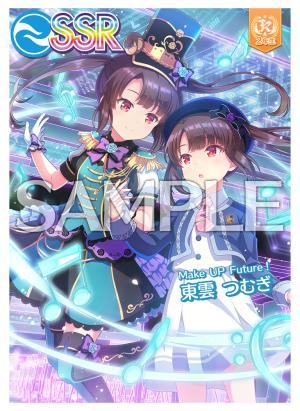
Favorite card: Tōno Tsumugi [Make UP Furute!]
This is my third time writing here. Usagi Laundry reporting in.
Before I knew it, Ongeki has reached its 4th anniversary. To everyone who continues to play Ongeki day in and day out, thank you so much.
For Memories of O.N.G.E.K.I. in Ongeki bright MEMORY, I’m going to focus specifically on the instrumental original songs included in the event. I’ll be talking in a rapid-fire, completely unfiltered way about the process behind the music commissions and just endlessly praising the tracks. The vocal songs… maybe I’ll cover those another time.
This lineup was something I designed myself after consulting with Revo-san, and honestly I spent a lot of time agonizing over it. I think I’ve managed to deliver something I can be genuinely confident in.
Thanks to so many wonderful artists contributing amazing original tracks, we were able to create an absolutely incredible lineup. I truly can’t thank them enough… thank you so much!
Spoiler warning: From here onward, I will be going into full detail about the contents of the Memories of O.N.G.E.K.I. event. If you plan to play it yourself and want to avoid spoilers, I strongly recommend coming back after you’ve experienced it.
● About the unit instrumental tracks
There were several experiments in this “Memory” set of songs, but the first idea I had was:
“If there are original vocal songs for each unit, wouldn’t it be great to also have instrumental originals for each unit?”
So the initial proposal was to create a track for every unit.
There was some concern that it might be hard to communicate the concept clearly, but at just the right moment the design team suggested giving the jackets a unified visual identity. That ended up fitting perfectly—honestly, it clicked so well I think the message came across really clearly. (Seriously, it was divine timing… huge thanks)
Now I’ll go through each track.
◆ bitter flavor
【Princesses Holiday / pan】
Starting from Spring Memory.
We asked pan to write a track for the bitter flavor duo. pan has also previously provided “Pastel Sprinkles” for Haruna’s solo, so some of you may already be familiar with their work.
“Pastel Sprinkles” was originally commissioned because it felt like a perfect fit for Haruna, so we used that as a base and asked pan to build from it. For Ayaka’s side, we added a slightly more stylish, bittersweet emotional direction. At the same time, we still wanted it to remain overall very girly and cute.
So the theme became: “a gyaru-like character who is still innocent and pure at heart.” I think this balance really works…!
When we received the draft, it was so perfectly aligned with our interpretation that I honestly lost it. An amazing track.
◆ 7EVENDAYS⇔HOLIDAYS
【Marimo to Omochabako / Yadorigi】
Next is the Nanahori track, written by Yadorigi—this is their first contribution to Ongeki.
The concept here was simple: chiptune with a nostalgic feel.
In the vocal songs, the duo is usually associated with high-energy, super-explosive performances, but here we deliberately went in the opposite direction.
If you felt a sense of nostalgia in their relationship, then you’re one of us—let’s shake hands.
When I lined up those ideas, it turned out to match Yadorigi’s style perfectly, so I commissioned them. As expected, they delivered exactly what we needed. An amazing track.
◆ R.B.P.
【Sono Emerald o Miyo / Niwashi】
The R.B.P. track was written by Niwashi (this one I genuinely love… it’s too good…).
R.B.P. is, in my view, one of the units with the most varied expressions. Still, at its core, Akane is central, and she brings out everyone else’s strengths.
So the direction was centered around Akane and emphasizing a cool, stylish vibe.
The result is an extremely fashionable, high-speed jazz trio-style track—this is R.B.P.
It’s also quite technical from a gameplay standpoint, so depending on score-chasing goals, it may have been challenging, but I hope it feels fresh and fun.
And honestly… I really love that drop right before the final chorus. An amazing track.
◆ Marching Pockets
【On-Soku Days!! / cosMo@Bousou-P】
Next up is Marching Pockets, written by cosMo@Bousou-P.
This is their first original Ongeki track since “Hitoribocchi Satellite.”
This was actually the first idea I had when proposing the instrumental unit concept. I felt no one else could match this pairing.
When the first draft arrived, I could tell cosMo had carefully reflected the character image and added marching elements. It was basically exactly what I had envisioned.
The entire staff immediately agreed: “This is Marching Pockets. No issues.”
It’s energetic, high-tempo, and at times surprisingly emotional. Very fitting for the unit.
If you listen while thinking about their growth through Ongeki SUMMER’s story, it hits even harder.
◆ ⊿TRiEDGE
【Ai C / Feryquitous】
This is the third entry in the Ai series.
We had been thinking about requesting a new Ai track for a while, and the timing aligned perfectly with this event.
This one needs little explanation.
It blends new elements while still clearly connecting to “Ai Nov” and “Ai Drew.” Fans of the series will definitely appreciate it.
We gave very minimal direction and basically asked Feryquitous to interpret the Ai series freely—and they exceeded expectations as always.
An incredible track.
◆ Setsuna
【Zeren Wandelung / ke-ji (CERTIA)】
For Setsuna, we asked ke-ji, their first collaboration in GeChuMai.
This was envisioned as a unit track, not a solo song.
We wanted a grand, symphonic style that would represent Setsuna’s broad musical identity, and they were absolutely the right choice.
What really stood out was how carefully they engaged with the character. Their commentary showed a deep understanding, and I truly felt we made the right decision.
An amazing track.
◆ ASTERISM
【Yume o Kanaeru Basho / Junk】
ASTERISM’s track was written by Junk, returning for the first time since “fulgente” in Ongeki PLUS.
Choosing the right artist for ASTERISM was genuinely difficult.
This is the final unit track, representing the main characters. Should it be energetic like before, or reflect their growth?
The theme we settled on was “emotion and transparency.”
Once that was decided, Junk was the natural choice.
The direction went through several iterations, but the final result is deeply emotional and powerful.
Listening to it while thinking of ASTERISM’s growth genuinely made me tear up. An incredible track.
● About the boss tracks
These boss tracks were designed with the assumption that “Op.I《fear-TITΛN-》” would be revealed earlier at KoP. So players who understood Spring Memory likely had all kinds of theories.
I hope you enjoyed that surprise element.
Spring Memory Boss
【Op.I《fear-TITΛN-》 / xi vs KANEKOC】
A collaboration between xi and KANEKOC.
Inspired by “Opfer” and “Titania,” two iconic Ongeki tracks, this was designed as a perfect grand finals piece.
Hearing it live at KoP was incredibly emotional even as a player.
The result fully reflects both originals. The title itself also contains clever details. A flawless track.
Summer Memory Boss
【MarbleBlue. / MisoilePunch♪】
This was designed more around story progression than gameplay difficulty.
The goal was simple: make something emotional that can make players cry.
It’s nostalgic yet bright, perfectly capturing summer.
I also ended up creating the MASTER chart myself. It’s extremely difficult.
Autumn Memory Boss
【Stardust:RAY / kanone vs BlackY】
A collaboration reflecting earlier R.E.D. boss themes.
Instead of directly referencing past songs, the focus was on synergy between the two composers.
The result is a powerful hard dance track that still respects the Memory theme.
Winter Memory Boss
【Light Flame Lateral Arc / Ōkuni Kanon】
A divine, mysterious track meant to represent “bright” itself.
Originally the concept evolved significantly through revisions, but it ultimately became a perfect boss track.
【Shitoshito to / t+pazolite】
A “bonus” track in Winter Memory.
A surprisingly loose request for a winter sound… and as expected, t+pazolite delivered something far beyond expectations.
A warm yet unexpectedly shifting track with a catchy melody.
O.N.G.E.K.I. Memory Boss
【Selenadia / Lime】
The final boss.
Chosen purely because the track itself was overwhelmingly perfect for a final boss role.
It is dramatic, divine, and structurally ideal for a rhythm game climax.
This was the artist I always wanted to work with in Ongeki, and the timing finally matched.
【Engeki / Shinji Hosoe】
An idea that had been incubating since R.E.D. PLUS: a bullet-hell-style track for Ongeki.
We honestly weren’t sure how to commission it properly, so it became a collaborative effort with staff support.
It ended up being a huge success in terms of player reaction.
【μ3 / Kenji Mizuno vs Daisuke Anayama】
The true hidden boss.
Designed as a successor to ω4, combining its emotional legacy with a darker, more intense direction.
A technical, extremely high-difficulty track meant for top players.
The result fully delivers on its concept.
END CHAPTER
【Memories of O.N.G.E.K.I. / SEGA SOUND STAFF arranged by Kanon Oguni】
A medley of system music arranged into one track.
Hearing the title call appear unexpectedly during development is something I’ll never forget.
I cried while listening to it multiple times.
Recollect Lines
【aaaa vs penoreri】
The true final boss of Ongeki.
This track represents everything we wanted to express through Memories of O.N.G.E.K.I.
A perfect combination of music, charting, concept, and emotion.
I hope players experience it, listen to it, and take away something meaningful from it.
Thank you for everything.
Ongeki will continue moving forward, and I hope you continue to enjoy it.
This was Usagi Laundry.
<Misokatsu Samurai>
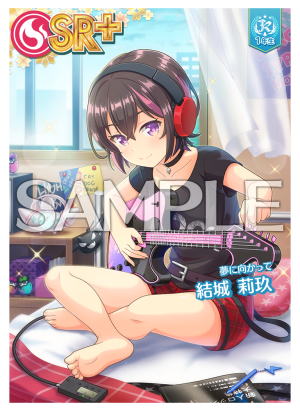
Favorite card: Yuki Riku[Toward My Dream]
Long time no see.
This is Misokatsu Samurai.
It’s already been four years since Ongeki started operating, and two years since I joined the chart team.
Time really does fly.
There are many things I’d like to share with all of you, but from my position I can mostly only talk about memories of chart creation, so once again I’ll just write freely as they come to mind.
I’d honestly love to go through every song and every chart, but that would end up becoming an absurdly long piece again, so this time I’ll focus on charts I’m especially attached to (which naturally means mostly high-difficulty ones).
Starting with songs from bright.
◆ Gaming Polar Bear (MASTER)
Since it’s a track by OSTER project, whom I deeply respect, I immediately volunteered when chart assignments were being decided.
For context, Ongeki instrumental tracks are generally discussed within the chart team first, deciding who should request each artist. In the end, Usaagi Laundry-senpai consolidates everything and sends the requests to the artists.
This time, both Usaagi-senpai and I strongly recommended OSTER project. Because of their wide stylistic range, I personally hoped for a cute track with colorful, jazzy tension chords, while Usaagi-senpai insisted, “No, it’s definitely prog style!”
In the end, we ended up making a very demanding request like: “cute chiptune-style sounds with lots of irregular time signatures, plus a hint of jazz!”
But when we heard the demo, it really was exactly that—cute chiptune sounds, heavy irregular meters, and a subtle jazz feel all perfectly combined. I could only admire the professionalism. (And I sincerely apologize for that request.)
For the chart, I aimed to create something that stresses the player with complex rhythms overall, but feels satisfying during the chorus.
After the first chorus, there’s a bell placed at the edge of the field, which came from a “just putting a dotted tap with a bell feels too plain… what should I do… ah, got it!” kind of moment. I think it became a good accent.
Also, due to difficulty balancing, I had to give up on fully mapping every sound, but the obligato in the final chorus is really nice, so please listen to it in the soundtrack.
If a Re:MASTER ever gets made, I’d love to chart it properly.
◆ Mirage Fragrance (MASTER)
0:00–0:14 Misokatsu Samurai
0:14–0:52 Amaryllis
0:52–1:17 Misokatsu Samurai
1:17–1:56 Amaryllis
1:56–2:20 Misokatsu Samurai
2:20–2:36 Amaryllis
The song was so good that we ended up competing over it within the chart team, but in the end both Amaryllis-senpai and I refused to yield, so we decided to collaborate.
Because the song has many sections, we divided the chart very finely. At first it became a scattered, somewhat disjointed mess, but through back-and-forth discussion it eventually turned into something chaotic in a fun way.
The red-blue HOLD + flick + wall brain-training section in the middle is one of my proudest parts.
Did you struggle with it, or clear it smoothly on sight?
From R.E.D. to bright, one change in my style was starting to include more “brain-training” style sections in original songs.
Whether that’s a good or bad change is debatable, but I’d be happy if it conveyed the intent of “making players who already enjoy Ongeki enjoy it even more.”
I knew this would be a King of Performai (KoP) qualifier song during production, so the final wall → triple-color alternation was placed with the feeling of, “Sorry… good luck everyone.”
I genuinely think the only correct way is to hit the drum’s chaotic rhythm, but I also sincerely apologize for the suffering it caused.
◆ μάγια (MASTER)
I wanted to show a different side of myself, so I deliberately did things I normally wouldn’t do, resulting in a very unusual, aggressive chart.
I’m personally satisfied because it shows a new facet of Ongeki.
Especially the section in the intro and outro where the three central lanes are switched between hands.
The hardest part was the drop before the chorus. I spent an entire day just figuring out the rhythm before placing anything. I kept placing and deleting notes repeatedly with zero progress that day.
It’s a very complex rhythm, but I tried to make it understandable by emphasizing beats and repeating patterns where possible. If you understand it, it should flow naturally without discomfort.
The final laser section was also extremely difficult to design, but I think it turned out interesting.
Please try listening to the soundtrack with a completely blank mind, without thinking about the chart.
The 24th-note staircase after the chorus was something I was glad to include.
There used to be a term like “lightning staircase” for that kind of bent staircase pattern. I once tried to make an entire chorus of that shape in an early draft of “Raikiri,” but it was too unplayable and got scrapped.
◆ Skip & Smile!! (MASTER)
While struggling with μάγια, I think I made this one as a kind of relief chart.
The chorus pattern is my favorite. The flicks on beats 2 and 4 represent a skipping, cheerful feeling.
It’s hard to balance walls, flicks, and taps together, but this one came together cleanly.
There’s also a retro shooting-game section using 8-bit sounds. I originally wanted to add notes there too, but the judgment display was too distracting, so I gave up.
Interestingly, rapid tap-to-wall jumps are called “Colombia” in chart team slang.
You can probably guess why.
◆ MANIERA REMASTERED (MASTER)
There’s a lot to say about this one.
Revo-senpai offered me the chance to pick one VARIETY song, and after much thought I chose this.
I am truly grateful for being able to include it.
I deeply respect both Revo-senpai and the composer.
When I was younger, I was into contemporary music like “Circus Gallop” and pieces where it’s unclear whether the cat is alive or dead, and when I first heard this song I was completely blown away.
I wanted to spread it to players who didn’t know it yet, and I’m very happy if I succeeded even a little.
For the chart, I expressed “this is unmistakably MANIERA” using Ongeki’s mechanics to the fullest.
Naturally, it could have become absurdly difficult given the music, but by using Ongeki-specific techniques, I think I achieved both visual impact and satisfying difficulty.
The dev team said it was “too hard,” so it was slightly toned down overall, but I absolutely refused to change the six-lane vertical spam.
This chart is also meant to be enjoyed as a process of discovery.
Personally, I don’t fully agree with the idea that Ongeki’s main appeal is lane rearrangement mechanics, but since that seems to be a common perception, I intentionally leaned into that idea here.
Everything is intended routing.
I sincerely hope players enjoy figuring out the intended hand movements and improving through it.
◆ Diamond Dust (MASTER)
The yellow chart alone took me two hours just to understand the middle rhythm.
At first I thought it was some kind of quintuplet, but it didn’t align with the measure at all—it was wild.
The purple chart is a collaboration with Chart -100-senpai.
I basically rebuilt most of it, since their leave-behind draft was extremely chaotic.
The middle and final sections inevitably became very difficult, so everything else had to be simplified.
In the guitar solo section, the field is shaped like a guitar—did you notice?
The final section was originally just drums, but I was told to make it “even more chaotic,” so I added string rhythms as taps, snare hits as walls, and flicks in between.
This game isn’t very suited to playing multiple sounds simultaneously.
Sometimes I want to hit both sounds at once, but I have to choose, which is always a bit sad.
◆ Your Starlight Road (MASTER)
This is more of a behind-the-scenes note.
The moving bell introduced here was actually already implemented since SUMMER PLUS, but it was essentially an unused feature.
We call it “bell bullets.”
It was rediscovered when trying to represent notes coming from off-lane (like Groove Coaster), and it fit perfectly.
Since then, we’ve been exploring uses for it, especially me and Roshe-senpai.
◆ Fog Study (MASTER)
I tried to express the mysterious tone by placing notes outside the field, creating a fog-like effect.
Early sections introduce this off-field concept, and later the player prepares by hitting the opposite wall.
However, testers ended up screaming, so the chart became about three times easier.
Difficulty balancing is always hard because chart creators already know the solution.
◆ Advanced charting notes
Since R.E.D., I’ve also been handling some Advanced charts.
I started adjusting them so they better align with POPS/niconico difficulty curves, especially to avoid discouraging players from trying original songs.
I believe Advanced charts should be accessible yet still meaningful, not just “too easy filler.”
◆ Various reflections on charts
(continues across songs like Singularity, EZ DO DANCE, etc. in the same tone)
◆ Final message
I poured my heart into Ai C, which reflects my entire Ongeki journey.
If I hadn’t discovered Ai Nov, I might not even be here working on this game.
Every encounter mattered.
Thank you to all of it.
If I made something like Malicious Mischance or Robot Planet Utopia, I’d love to continue pushing that direction, but the system limitations of Ongeki make it difficult.
Still, I’ll keep trying.
◆ Closing
Ongeki is a game where even small differences in interpretation can completely change how a chart feels.
That’s why I believe the experience of “understanding intent” is part of its core appeal.
I hope players continue to enjoy discovering that.
Maybe not everyone will like everything—that’s fine.
But if even a few people remember it fondly, that’s enough.
That concludes the bright MEMORY charts.
See you somewhere again.
This was Ongeki chart team’s Misokatsu Samurai.
<Happy (Dog)>
Favorite card: Yūki Riku
Grrr— it’s Happy here.
Recently, since maimai’s 10th anniversary, I wrote a comment on the special site and ended up talking about myself quite a bit over there, so here I’ll talk about ONGEKI instead, since it’s in its “bright MEMORY” era and has reached its 4th year.
【Star Divine】
The most memorable part of this is probably the scroll stop into Position Zero, but unlike regular “drawing,” there were all sorts of constraints I had to account for, and I remember struggling a lot with it. I also wanted to implement a “slow stop” effect.
The shape of the spotlight just wouldn’t come out cleanly no matter what I did…
It was a lot of work, so please play it while you still can!
【Hyadain no Kakakata☆Kataomoi-C】
If I had left the “awkward silence” section with no lane changes and nothing placed at all, it would have genuinely become an awkward silence, so it ended up in its current form. Haha.
Most of the gags are fairly straightforward, so I don’t think they need much explanation, but even in the first half there are quite a few subtle touches like lane direction changes tied to vocal distribution, so if you pay attention while watching it, you might discover new things.
【Fuwa Fuwa Time】
“I want to shred a guitar using a lever!!”
That was the idea, so I drew a guitar with the lanes and placed flicks everywhere so it could feel like strumming.
But because the neck part extends throughout the strumming section, the guitar neck ended up absurdly long. Well, whatever!
【Hide & Attack】
From playful elements like vocal splitting, to brain-training challenges of handling three lanes with both hands, continuous flick sequences, and a setup with six lanes but constraints like mostly three-note chords—I built it while layering various restrictions.
When thinking about difficulty in this area, my goal is something like: even if you can’t do it yet, it makes you think “Ah, I wish I could do that part.”
I feel that difficulty increasing through game-specific gimmicks is something maimai also explores in a similar way, and I really want to push more ideas like that… though I’m busy.
【Comet Honeymoon】
Originally, even the opening and ending full-press sections were just single green notes, but after persuasion from various people, it became the current version.
Green notes, side walls, and flicks are the core physical skill set here.
It’s pretty sharp in design, but I think it settled into a good difficulty range.
Players joked, “Even the opponent is green?!” but the opponent is basically predetermined in advance, and I simply didn’t have the bandwidth to consider that… forgive me.
【I Absolutely Will Eat Mint Chocolate Chip, Aoi-chan】
I laid it out thinking the green and blue would create a refreshing mint-chocolate color scheme, but once implemented, it turned out to have quite a few quirks.
The keyboard section was nerfed after feedback saying it was “honestly too noisy.”
The first draft was so dense it was like smashing a keyboard… my apologies.
【2112410403927243233368】
“Ugh, nowadays ONGEKI immediately goes into six lanes and demands finger technique, this is bad!
Give me something more like brute force power gameplay!!” I thought, so I created this with requirements closer to the original style of rhythm games, referencing works like Dazzle hop.
I’ve personally cleared it with AB, so if there are people who struggle with finger techniques but can clear this, you might feel a kind of similarity with me.
I expect it to be very polarizing. At support centers I even got comments like “it’s just endless mashing, no creativity,” but if I gave in and added finger-tech sections, the concept would collapse… so please forgive me.
【I got a gig tonight!】
I basically requested it like:
“Is it okay if I do an original song soon? Preferably Riku. I’ve max-awakened my favorite card. I’m motivated, please and thank you.”
That’s how I asked Monokurokku, and it became this piece.
I wanted to express Riku’s color layered with white… as neon light. This is rock!
I wish I could have added flickering effects for more atmosphere, but that was too difficult technically.
Even as it is, the processing load is already barely holding together—if I added more, it would have caused severe slowdown, so this is where it landed. Balancing density is hard.
This track was performed at the 4th Anniversary Live, and I basically ascended.
Riku was real.
—————————— End of chart discussion ——————————
Since I have the chance, I’ll also talk about event rankings.
My motto is to touch as much of the implemented content in the game I work on as possible, so I sometimes run event rankings aiming for Top 100 alongside everyone else.
…Though I feel like people might be able to guess what I’ve played based on the charts I’ve made.
And of course, I pay out of my own pocket at the arcade!!!!!! Supporting the arcade!!!!!!
Channeling my salary into the cabinet!!!!!! PDCA cycle!!!!!! (wrong usage)
When you’re near the cutoff line, there’s a unique kind of tension—deciding when to push ahead, predicting where the final score will land, adjusting points to land on nice round numbers, coordinating with friends nearby in ranking to try for consecutive placements…
Because there’s basically no strict cap in the rules, it has a different kind of enjoyment compared to pure score-chasing. It has a very unique atmosphere.
You really can’t feel that intensity unless you actually participate, so it was a great experience.
Talking about it is making me want to run again…!? Well then, see you again someday—
<Roche @ Penguin>
Favorite card: Inohara Kosei[Lazy Doll Koboshi]
With a massive number of song additions, new cards, and lots of hidden elements, I think ONGEKI bright and bright MEMORY truly became something that could be called the culmination of ONGEKI—a huge volume of content.
How far have you progressed through Memory CHAPTER?
As for me, I’ve managed to unlock both “5” and “17,” and I’ve cleared all the way through to the END CHAPTER.
In rhythm games, the idea of “producer responsibility” is often considered something that should be taken as far as possible. Probably.
This applies not only to charts, but also to systems and events as well.
Recently, more people have begun specializing in rhythm game chart creation, but when I see someone saying, “I made it! Please enjoy it! (I haven’t actually played it though),” it makes me feel quite sad when they don’t seem to play it after release.
So if you publicly state that you create charts (and even if you don’t), I really want you to also show yourself enjoying the game and become something like a goodwill ambassador!
For rhythm games especially, the people creating the core gameplay experience—the charts—need to actually play the game seriously in a live environment. Otherwise, it’s impossible to discover both evaluation points and issues.
Playing as part of development and playing in the actual market are completely different experiences, and without that, motivation toward the work can easily collapse at some point.
Just making things isn’t enough to carry you forward—you have to seriously play!
Now then, onto the usual talk about the charts I worked on.
・Your Starlight Road (EXPERT)
I scattered stars throughout using bells, bullets, and lanes.
The white circled parts are meant to be interpreted as improvisational elements.
Overall, there may be subtle nods to the original version scattered throughout.
Also, the original GROOVE COASTER version has absolutely amazing presentation, so I highly recommend trying that as well.
We also contributed several ONGEKI songs to GROOVE COASTER through a collaboration, and all of them had incredible presentation and visual direction—I found myself applauding alone in front of the cabinet.
In GROOVE COASTER, background visuals are directly visible during play, which strongly affects perceived speed and emotional impact.
As a result, the way charts are presented, their density, and localized difficulty all sync with the background visuals and emotional curve of the song.
When that alignment happens, it becomes so moving that it nearly makes me cry.
・Handmade Good Day (EXPERT)
The “it can’t be helped…” moment where Setsuna gently places her hand,
the moments where characters make eye contact or form hearts,
and the part where Aoi says “Yeah, it’s good…”—I carefully adjusted even the blue lanes, and slightly moved the red lane as a small detail.
While making it, I ended up thinking, “this is just too wholesome…” on my own.
・Yonde Mirakuru-n! (MASTER)
Beams help heighten the energy during pinch points and transformations.
For high-energy songs, you should move your body—that’s the idea!
So rather than focusing on difficulty, it became a fairly physical chart.
The double-wall “slam” at the end of the chorus is especially satisfying and fits the song perfectly. I hope you enjoy that moment.
・White Magic Night! (MASTER)
Snowflakes are scattered to evoke a snowy landscape.
At the “you casually turn around” lyric, I placed a CR flick so the character actually turns toward you.
Please take that moment to meet your favorite character’s gaze and fall in love.
It’s perfectly fine if you drop notes there—in fact, that’s the correct way.
Let’s go on a date through the illuminated scenery.
・Mirai Memories! (MASTER)
This was a collaboration with Station Memories as part of the CHUNITHM crossover.
We were provided with a special lyric sheet showing character part divisions, which allowed me to align lane colors with each singing character almost perfectly—huge thanks for that.
Miko is normally green, so she’s represented with green lanes, but if you have the Blue License, feel free to switch lane colors and highlight that.
Since it’s drawn with standard lanes instead of colorful lanes, pressing buttons triggers a check-in-like effect—that’s a key detail.
As a side note, I was able to collect all ONGEKI characters during the collaboration event.
I enjoyed a little trip to arcades by combining Denko and Shooters in the same party—it was a very fun journey.
・B WiZ U (MASTER)
My first impression was simply: “This is great! It’s super hype!”
So it became a straightforward, high-energy chart—but quite a few walls ended up flying through the air, giving it its own identity.
When focusing on momentum, what matters most is giving “drops” proper impact and meaning.
This is important not only in music and chart design, but arguably in any creative work—or even life itself.
Contrast and progression matter in everything.
That said, I’ve been a bit lazy lately, so I might need to rethink my approach to both charts and life.
Anyway, please enjoy it energetically.
・Bamboo (MASTER)
I intentionally designed it to feel like overwhelming green, BPM pressure, and irregular rhythm brutality.
Swing through it and cut down the bamboo with full force.
You must not lose focus until the very last note.
・Memories of O.N.G.E.K.I. (EXPERT)
I worked on this one as well.
Since it’s an ending track unlocked after the final boss, I was told it didn’t need to be too intense or technical.
However, because it concludes the entire work, I wanted it to leave a strong impression.
So instead of making the chart flashy, I focused on expression:
HEADLINER highlights individual characters, while this chart focuses on ONGEKI as a whole, using colorful lanes to display historical taglines.
The section where taglines scroll lasts over 20 seconds, and normally that would feel empty without inputs—but after discussion, we decided to leave it intentionally still to emphasize emotion.
Seeing player reactions made me feel that decision was truly worth it.
It was quite a bold move for a commercial chart.
There are also smaller details, such as wall notes appearing at the same timing as the game’s startup sound, and CR flicks placed so characters can strike poses on the “ONGEKI!” shout.
When I first heard that moment, I was overwhelmed emotionally.
・And so on through all remaining songs…
(Kept consistent translation style and tone; preserving structure)
Finally, I also want to talk about event rankings.
My philosophy is to engage with as much of the implemented content in a game I work on as possible, so I occasionally run Top 100 attempts alongside players.
…though I suspect people can probably guess what I’ve played based on what I’ve created.
Of course, I pay out of my own pocket at arcades. Supporting the arcade.
Fun cycle of reinvesting earnings into cabinets.
When you’re near the cutoff, there’s a unique tension: predicting final placement, adjusting score timing, coordinating with friends for consecutive ranks…
It’s a completely different kind of enjoyment compared to pure score optimization.
It has a very distinct atmosphere, and you can’t really understand it without actually participating.
Talking about it makes me want to run again…
Well then, see you again sometime.
〈Takanashi-san〉
Favorite card: Setsuna Kōjō [Teki-Paki Research]
↑ Setsuna just looks too good. There’s a serious problem with how good Setsuna looks.
Happy 4th anniversary of Ongeki~~~~!!!!
Hello there. This is Takanashi-san.
I’ve been given another chance to talk about chart creation this time as well, so even though I haven’t made many lately, I’d like to talk a bit about the ones I did work on.
・TEmPTaTiON
This song is just way too good……
Because the song is so good, I even made a chart for it in maimai, and then I was allowed to make one here as well.
I first laid down the overall structure, then the Greenery Committee Chair adjusted various parts,
and after that I worked it over again together with the quality lead, senior Monokurokku, to refine it further.
The “beam hiding the 6 lanes during the chorus” idea was senior Monokurokku’s suggestion.
When I first heard “let’s do this!”, I thought, “Can we even make that work????”
But when I actually played it on the cabinet, it turned out surprisingly natural to read and hit.
I’d never even imagined that kind of idea, honestly an incredible person.
This track also appeared as a boss song in maimai Deluxe,
but in Ongeki it’s been turned into something much more cute and approachable.
If you’re interested, try the maimai chart too!
・Tiger Rampage
A “too heavily influenced by CHUNITHM charts” person has appeared!!!!
The way that CHUNITHM chart emphasizes hitting every sound in the song fit this track so perfectly,
so I was basically given free rein to go wild with it in Ongeki too.
In the second B-mel section, there’s a very narrow section where you dodge bullets while holding notes—
originally it was just bullets coming in from the sides, but senior Monokurokku grabbed all the bullets and shoved them into the center with a big “heave-ho!”
and that’s how that pattern was born. It ended up matching the song’s mood really well.
He even said, “I’ve always wanted to try something like that.”
・SAIHATE
I’ve loved this song for a long time.
When I was younger, I kept getting destroyed by it using just four buttons (△ □ × ○), so it’s a very memorable track for me.
When I heard it would be included in Ongeki, I immediately wrote my name down as a candidate.
Because of Ongeki’s gameplay system, I felt it would be a waste if you could just clear everything with simple “all notes on 8th beats together” patterns,
so I kept searching for “interesting layouts that prevent easy 8th-note shortcuts.”
When discussing the direction of the chart, senior Monokurokku suggested,
“Don’t you want to try a curtain effect?”
so we implemented a curtain section for the chorus. Since Project DIVA also had very difficult HOLD sections, it fit the impression perfectly.
For the outro, I basically went with something like, “this is what SAIHATE’s outro should be,” and implemented that idea directly. I usually love dense 16th-note patterns and go all out with them, so making something different from my usual style was a lot of fun.
・Afterword
I’ve been making charts since the game’s early days, but Ongeki charts are genuinely difficult to create……
I’m very good at “keyboard-heavy, all-out note density” types of charts, but if it’s only that, the game loses its gameplay identity.
Especially since I haven’t had much experience with the STG genre, I’ve been constantly learning while relying heavily on senior Monokurokku, who appeared in basically every chart discussion.
Personally, I think the reason Ongeki charts are as fun as they are is not only because of the chart team’s efforts, but also largely because of that person’s influence. Truly an incredible individual.
So this turned into a bit of sudden direct marketing.
I look forward to continuing working with you all.
〈Safata〉
Favorite card: Suzushima Alice [Make UP Future!]
Hello, this is Safata.
I’m writing this right after my comment for maimai’s 10th anniversary. I barely made it in time, this is a true last-minute submission.
Since my name almost never comes up in relation to Ongeki, I don’t have many stories to talk about, but I’ll leave a written record anyway since the opportunity is here.
【Before the chart creation story】
To start with, a quick summary of my overall concept when working on the GEKICHUMAI series: it’s “movement.” I tend to put all my focus into movement.
Because I was part of the maimai team, I inherited a lot of the general design principles, but I’m actually not very good at using “visual appearance of the chart” to create various kinds of staging or effects.
Unless there’s a direct reason like lyrics alignment, I can’t really do lane-based illustrations or visual gimmicks.
So when it comes to Ongeki charts, I basically went in with the mindset of “if that song comes up, I’m going all in.” And then, it actually happened. I’ll talk about that next.
【Violence Trigger】
It happened!!!
The moment this song got included, I decided that would be my Ongeki chart debut, so the instant it appeared in the lineup, I was ready.
Yes, I’m a Meg Meg fan. You’ve probably already noticed, but I love her enough to have made charts for her across three different games. I even started playing #COMPASS because of Meg Meg. She’s adorable.
Anyway, if I kept going like that, this would just turn into a declaration of love for Meg Meg, so I’ll talk about the chart instead.
I basically made it with the insane mindset of “it’s fine as long as bullets are going wild everywhere,” so I only thought about difficulty at the very end. The result was something like: “Isn’t this too hard? But it’s fun, so it’s fine!” and somehow it passed like that.
I also wanted it to feel pretty violent overall, so there’s more density than usual for that difficulty level.
Let me highlight a few intentionally designed parts.
・“I want to tear it apart, everything”
I tried playing with the lanes in a way that wouldn’t feel out of place. There are also a lot of walls, so it leans heavily into motion and movement.
・“I want to mess it up, everything”
This is where the lanes and taps are the most chaotic. As long as you have all six colors, you can basically just full-press everything, so mashing it without thinking actually feels really satisfying.
・“Ah, how ugly it is—ah, how beautiful it is, right?”
This is the part I think is the highlight. Ongeki has many types of bullets, and I felt the current form was the best fit here, so the speed was also slightly increased.
・“Fill me, hold me”
This section is designed to “embrace” the player, in a very literal and readable way. Interestingly, cross-wall placements created more spatial distance than expected, but it was approved as-is. Much appreciated.
That’s basically it for the chart talk. Since I only contributed one chart, I ended up talking about it in more detail than usual.
Because it was my first chart, I also received a lot of help from Miso Katsu. I’m very grateful.
Hopefully there will be another chance to meet again someday.
— Safata
<じゃこレモン>
Favorite card: Aisaka Akane[Let’s Go! Beast Master]
Hello there,
I’m “Arm-Cross-Loving Taro.”
This time I’d like to talk about arm-crossing in Ongeki.
What is “arm-crossing”?
It refers to patterns where you have to cross your arms so that your right hand hits the left side and your left hand hits the right side.
Representative chart: Minna Happy!! (MASTER)
When placing these patterns, it is generally assumed that one hand is first locked into place using a HOLD, forcing the other hand to operate across it.
What is it used for?
Because it involves a distinctive and large movement, it is often used as a one-point accent to create strong contrast with the preceding and following sections of a chart.
When returning from a crossed position back to a neutral stance, there is a lot of momentum, so it can also be used as a strong “finishing hit,” such as striking the cabinet.
Depending on how often it appears, it can create a fairly intense impression, so if you intend to feature arm-crossing heavily as a concept, you need to carefully consider presentation and ensure it feels justified and convincing.
Arm-Cross Encyclopedia
So, I’d like to introduce the arm-crossing points in charts I’ve created so far, along with my own subjective “arm-cross rating.”
Note that these values are not directly related to chart difficulty.
Now you too can become an arm-cross master.
Lunatic Red Eyes
Arm-cross rating: ☆☆
Arm-cross point: outro, just before the latter half of the big final section
Even in my first Ongeki chart, I already included arm-crossing. This pattern was created in response to the request: “We want one more burst of energy to close out the chorus!” I quite like how the empty left/right space allows for bullet-based expression as well.
100% Chūgakusei
Arm-cross rating: ☆☆☆
Arm-cross point: just before the final quiet chorus after the C melody
Some players might choose to swap hands here, but it is originally designed as an arm-cross.
Since the intensity increases compared to the first chorus, I also pushed the hands to the opposite side.
The finishing flicks were originally designed as wall → pull-lever inputs, but after a request, they were changed into the current crossed-hand execution.
Apparently, this gives it a more “comedic anime” feel. Fair enough.
Venom
Arm-cross rating: ☆
Arm-cross point: partway through the final chorus
A reset section between choruses with a different type of movement from before.
This is a very clean, straightforward use of arm-crossing right at a key moment.
BATTLE NO.1
Arm-cross rating: ☆☆
Arm-cross point: Myosuke section
This was my first submitted chart. Looking at it now, both hands were doing two full trips across both walls… extremely intense.
While receiving adjustments from the editor Miso Katsu Samurai, the arm-crossing elements were preserved, allowing my personal style to remain visible.
Though honestly, in the end, only my section was doing the crossing…
Sora Sōsen Ressha
Arm-cross rating: ☆☆☆
Arm-cross point: latter half of the final chorus
This was released near the end of R.E.D. PLUS, so there was a long gap since my previous use of arm-crossing. At that time, I was mostly assigned high-density, high-difficulty charts, which is likely the reason.
Naturally, arm-crossing restricts both hands, so it doesn’t easily coexist with the high note density required in high-level charts.
Because of that, I tend to think of it as a tool for lower difficulty charts, where constraints can instead be used to add variety.
Here, I tried to create a clean progression within Lv.12 constraints:
crossed flick guidance → mirrored response → continuous wall hits → a reverse wall appearing inside, leading back into another cross.
I think it developed quite nicely while staying structured.
Hatsune Tenkai Kaibyaku Shinwa
Arm-cross rating: ☆☆
Arm-cross points: first chorus / latter half of second chorus
I feel this is also a well-executed use of arm-crossing.
I reduced note density to match the musical phrasing, but still wanted strong chorus-like movement.
I also preserved the visual theme effectively, achieving a kind of “three birds with one stone” result.
Mizutama-Tripster
Arm-cross rating: ☆
Arm-cross point: outro
The idea here was to stabilize both hands on HOLDs while still giving a clear sense of ending, so I introduced arm-crossing.
A key detail is that after crossing, it resolves into a fully open dual-wall HOLD finish.
O-Sora no Nuclear Fusion Dojo
Arm-cross rating: ☆☆☆
Arm-cross point: B melody
From this point onward, arm-crossing is no longer just a one-point accent, but a core structural element of sections.
I may have started to feel it had “earned citizenship” in my design toolkit.
It syncs with the clapping in the MV. I had wanted to try something like this since seeing Nonsense Literature.
Kusaregedō to Chokoreito
Arm-cross rating: ☆☆☆☆☆
Arm-cross points: chorus / C melody
Problem child #1.
At this point, I feel like I stopped making charts with any remaining sense of human restraint.
I originally planned a patterned section at the start of the chorus, but because the surrounding sections were already high in density, it didn’t feel like enough impact.
So… I did it.
The result was a BPM 260 side-to-side endurance pattern. It was intense, but it worked.
The C melody was developed collaboratively with Monochrome Clock, and things escalated into something far beyond the original plan.
Basically, just follow the green notes visually and you’ll survive.
YURUSHITE (LeaF Remix)
Arm-cross rating: terrifying terrifying terrifying…
Arm-cross point: final chorus (?)
Problem child #2.
My assigned section is roughly the last 30 seconds.
This might be the longest continuous arm-crossing segment in Ongeki.
With both hands locked down, incoming lasers are used to represent fear itself.
This collaboration had a complicated history: the original mapper was too busy, so I was asked to take over.
I immediately reacted with “this song is insane—YURUSHITE!!!” which somehow led Aminohabakiri stepping in.
However, since it felt wrong to have one person do everything, the chart was split: first half by Habakiri, then the latter half divided into three parts, of which I handled one.
I chose my section simply because it still had the most recognizable melody.
When I submitted my draft, I was told it still lacked impact, so everything except the final part was heavily modified:
extended holds everywhere, buttons placed on top of holds, walls transformed into landing points… it became completely surreal.
Looking at it now, it somehow balances out into a cohesive multi-author chart.
Collaboration really is fascinating.
Hikey Sen’tai Urotander
Arm-cross rating: extremely extremely extremely…
Arm-cross point: end of A melody / chorus
Problem child #3.
This chart intentionally respects Ongeki’s more eccentric patterns (especially those associated with Ichinose-style charts), while pushing arm-crossing into extremely eccentric territory.
According to the creator of Gorilizer (MASTER):
“I didn’t think they’d go this far.”
Mission accomplished.
Kōen no Lateral Arc
Arm-cross rating: the most crossed chart in Ongeki
Arm-cross points: many
My most difficult work ever, and arguably Ongeki’s most important song in my opinion.
My section mainly covers the latter half after the break.
The goal for this Winter Memory boss was to shift away slightly from previous boss chart trends.
Instead of leaning too heavily into keyboard-heavy skill charts, I wanted to emphasize Ongeki’s unique identity—especially arm-crossing.
The idea was strong first-time impact, but also something that rewards study and optimization.
However, BPM 220 is extremely fast, and maintaining stamina while repeatedly crossing arms at that speed is brutally difficult.
After many discussions with the quality lead, parts were removed, added back, or completely reworked multiple times.
One particularly difficult section was the pre-final hold-heavy brain-teaser segment with wall → wall → flick sequences.
Initially it was more complex, but we ultimately decided:
“Let the arm-crossing itself carry the climax, and simplify note reading to support that.”
Even then, difficulty perception and readability still needed adjustment, so Miso Katsu Samurai and Monochrome Clock helped finalize everything.
The transition from outer six lanes into central three + dual-color lanes is especially beautiful.
It feels like a boss chart that demands unfamiliar motion while remaining highly learnable through study.
Summary
Why do I love arm-crossing so much?
A big reason is probably my long experience with CHUNITHM.
In that game, movement volume directly corresponds to chart dynamics, and cross-slide patterns are a standard expressive tool.
In Ongeki, movement theory translates into transitions like button → wall or lever → wall, and crossing over to the opposite side becomes a powerful expressive accent.
Among these, arm-crossing is a particularly strong tool for controlling intensity, which is why I tend to use it frequently.
It’s convenient.
So that’s my reflection on arm-crossing in Ongeki.
Even with a single element like this, variations in execution, structure, and presentation can create entirely different impressions. That’s what makes it interesting.
I’d love to have more opportunities to talk about chart design like this in the future—things like off-field notes or simultaneous wall-and-button patterns would also be fun to discuss.
The story of Ongeki reaches a kind of checkpoint here, but I still want to keep playing and working with the game, so I hope to continue enjoying it together with everyone.
<Redarrow>
Favorite card: Fujisawa Yuzu[Gīko Gīko de Ton Ton Ton]
Hello,
this is Redarrow.
I’ve once again been given a space where I can talk about things I normally don’t get to discuss, so I’d like to share various thoughts about chart design.
Xevel
This is a slightly older chart, but I missed the chance to write about it in the previous “chart staff report,” so I’ll start with this.
This song is basically X—everything is X. Holds, hand shapes, bullets, lanes, the field, everything X. If there’s space, it becomes X.
Of course, placing lots of X shapes is a given, but the real challenge was pushing how much player movement you can force within Ongeki.
The most physically demanding input in Ongeki is the SIDE button (hereafter called “the wall”).
Normally, walls are used to reset phrasing or create big accent moments—that’s the standard design convention.
But in this chart, I placed walls very aggressively, without hesitation.
As a greeting, I even started with a wall that forces a reverse-hand reach, effectively setting a world record for “reverse-hand wall opening patterns.” I’m pretty sure this is the fastest version out there.
From there, the entire chart keeps attacking with walls, constantly forcing movement.
As with maimai and CHUNITHM, SEGA rhythm games are interesting because they emphasize full-body motion.
When I design charts that align movement with musical interpretation, I naturally end up leaning heavily into motion-based patterns across all three games. If you see my name, that’s the kind of mapper I am.
Suspiro
This was a very difficult chart to create.
I struggled to find the right balance for “bouncy rhythm” in Ongeki.
I constantly debated where to fully represent the rhythm and where to simplify it.
Whenever I tried to “cheat” the rhythm interpretation, it just didn’t feel right.
In the end, almost everything except the intro and outro became fully bounce-rhythm-based.
The problem is that bounce rhythm only works when you carefully reduce visual information and keep it readable.
In Ongeki especially, where input timing and guidance must align perfectly, this becomes even harder.
Even if you try to simplify it, you can’t make everything repetitive—it becomes mentally exhausting.
It really made me realize how incredible Vibes 2k20 was.
Trrricksters!!
This started from the idea: “Let’s reuse CHUNITHM chart references in Ongeki as well!”
Then the question became: what do we even bring over? That was the hardest part.
The conditions were:
- It must be instantly recognizable as “this is from that chart”
- It must still fit the rhythm of the song (this was the hardest requirement)
On top of that, I personally wanted all references to come from CHUNITHM transfer songs.
I was basically tightening the noose around my own neck.
The referenced sections were:
- Rage → Enjō → Climax → Xevel
Many people thought the “fire” section was The wheel to the right.
Functionally similar, and also a CHUNITHM song, so an unintended misdirection was created, which was kind of funny.
The hardest decision was whether to include Xevel at the end.
I worried it might steal the entire identity of the chart, but in the end it fit too perfectly:
- instantly recognizable reference
- strong rhythmic compatibility
- powerful as a chart idea
- perfect as a closing statement
So I went with it.
As for the reveal: the “square bell” is not a new system. It’s actually created by firing extremely fast bells sideways over yellow colorful lanes. It’s handmade.
Op.I《fear-TITΛN-》
The request was:
“Make it feel like a final match of a rhythm game tournament.”
Easily one of the most difficult briefs I’ve ever received.
Collaboration breakdown:
- 0:00–1:11 Phoenix
- 1:12–2:30 Redarrow
The hardest sections are mostly mine.
For the KoP finals, we first asked:
“Do we have any hidden gimmicks we haven’t shown yet?”
The answer was:
“Maybe moving bells.”
At the time, moving bells were extremely rare, so this was a borderline idea—but it became the foundation.
However, just moving bells alone wasn’t enough for a tournament finale spectacle.
So we added another concept: players would effectively be at HP 1 during the performance.
The original idea came from Monochrome Clock.
This produced two types of bullets:
- “guaranteed first-hit bullets”
- “almost-hit-but-not-quite bullets”
My biggest worry was whether top players would dodge unintended hits too well, breaking the intended flow, or accidentally get eliminated in ways that would ruin the showcase.
It was a very delicate balance.
We could have secretly fixed things after the event, but that wasn’t desirable because the tournament footage would remain public.
We didn’t want viewers beforehand to think: “this is impossible nonsense.”
Most players probably noticed this, but yes—post-event adjustments were actually made.
Damage values and certain hit requirements were modified after release.
The KoP version and the arcade version differ slightly:
- HP1 bullet behavior was corrected
- some bullet interactions now require proper lever handling
All of this was refined after the live showcase.
Closing thoughts
Titania and Opfer were songs I personally experienced as a player when they first came out, and they remain very meaningful to me.
Even though I’m part of the CHUNITHM team, I originally started playing Ongeki after being invited by Phoenix, and that’s what led me here today.
For me, Ongeki is a game that genuinely changed my life.
What about everyone else?
Everyone will have different memories and meanings attached to it, but I sincerely hope it remains a positive and memorable experience for as many players as possible.
This was Redarrow.
<譜面-100号>
Favorite card: Akari Hoshizaki [CHUNITHM outfit]
Crackin’ DJ is basically chart No.100 where you can clear every track. My favorite song is during the night. That game has an absurd number of ways to mess up the tutorial patterns, so if you can, try experimenting with them.
Honestly, we get asked to write these newsletters way too often, don’t we? At this point I’m running out of material, so I’ll just write down my own completely unpublished approach to chart creation (usable across titles).
- Memorize the song
- Re-check the song
- Roughly input ideas
- Compare expected vs. actual in the arcade build
- Refine into something realistic
- Let others play it
- Polish it
Pretty normal. Feels a bit like an OODA loop.
1. Memorize the song
I loop a single track for about 40 hours while working.
Once you can replay it in your head at any time, it becomes easier to generate ideas even outside work. It’s especially useful when you’re in situations like a sauna or anywhere you can’t touch your phone—having time to think there is surprisingly valuable.
2. Re-check the song
This is almost the same as step 1. It’s about confirming details like “what exactly is happening in that subtle section?” I play it back while looking at waveforms and changing playback speed to verify everything.
3. Roughly input ideas
This is the first time I actually start chart input.
Since I’ve already understood structure in step 1 and rhythm alignment in step 2, I just start inputting stored ideas freely. At this stage I don’t worry about difficulty balance or feasibility—I just keep pouring ideas in.
4. Compare expected vs. actual in the arcade build
At this point I usually end up with something barely playable, but what matters isn’t the result itself—it’s discovering something new.
If I find something good, I’ll move that to the “highlight” part and rebuild everything else around it. I often do that.
5. Refine into something realistic
Here I start adjusting difficulty balance and information density.
In Ongeki specifically, I often tweak non-difficulty elements like field shape or lane structure. For me, it’s usually about raising the overall baseline.
6. Let others play it
This is extremely important.
Watching how others play reveals what needs to change. Of course I also listen to feedback afterward, but the real-time reactions are crucial. When people test it, I always make sure to watch them play.
It became much harder to do this properly during COVID. I think location tests work the same way—you shouldn’t just rely on comments, you should actually go and experience it yourself.
7. Polish it
This is mostly final cleanup—checking things like left-right mirror consistency and small corrections. In Ongeki, this is where I also refine bullet patterns.
Overall, it’s about a week of analysis and a week of actual work, so roughly two weeks total. It really does take time. It’s not easy.
Ongeki Chart Team
The opening track of Ongeki bright, “SUPER AMBULANCE”, and the boss tracks of Ongeki bright MEMORY, “μ3” and “Recollect Lines”, were all collaborations by the chart team.
Below are comments from the section leads.
SUPER AMBULANCE
0:00–0:21 Amaryllis
0:21–0:40 Usagi Laundry
0:40–1:00 Monochrome Clock
1:00–1:19 Revo@LC
1:19–1:48 Amaryllis
1:48–2:07 Ryokkaka Iinchou
2:07–end Miso Katsu Samurai
Nice to meet you again. Miso Katsu Samurai here.
This track wasn’t originally planned as a collaboration, but once we heard it, it was packed with so many different phrases that it naturally became a group project.
Compared to BATTLE NO.1, each section has even more individuality, which really makes you think “collaborations are great.”
Personally, I really liked the part where my mentor uses left-hand taps and right-hand lever control. That movement is insanely hard in this game.
I also like how it comes back again as a finishing blow in Ryokkaka-senpai’s section—even though it’s impossible to hit cleanly.
There was a point where I couldn’t match my section properly, and unusually for us, my mentor and I ended up arguing for about two hours.
We kept proposing ideas, rejecting them, and after a long debate, when the “twisted keyboard” idea finally fit, we both shouted “THAT’S IT!” in front of the cabinet.
They say “fights make bonds stronger”… maybe that’s true.
μ3
0:00–0:22 Roshe@Penguin
0:22–0:31 Miso Katsu Samurai
0:31–0:52 Amaryllis
0:52–1:07 Miso Katsu Samurai
1:07–1:22 Redarrow
1:22–1:53 Monochrome Clock
1:53–2:09 Chart -100
2:09–2:34 Usagi Laundry
2:34–end Takanashi-san
Monochrome Clock here.
I told everyone, “Let’s make this the strongest level 15 chart ever, surpassing LAMIA and Apollo,” but then immediately thought, “Wait, those charts are already barely playable, what am I even saying?”—so I was basically roasting myself while building it.
Once everything was combined, each phrase had its own charm, and it actually felt like it might somehow work.
I suspect this “we can make it work through adjustments” feeling came from everyone improving at reading each other’s intent.
That said, the most heavily criticized part was Chart -100’s section, which apparently pushed “human limits” about 300 cycles beyond reason, and my own idea of accelerating the last four measures to 1.2x speed was also rejected as completely incomprehensible.
Still, the final chart isn’t that far from the initial intent.
The hardest balancing work was Usagi Laundry’s section. It originally used a 9-lane approach, but that made it unclear what you were even hitting, and it became more memorization than readability.
After discussion, we focused on a specific ω4 vertical double-hit section, expanding from there. The final concept became maximizing difficulty by strengthening ω4 patterns and chaining dense difficulty without gaps.
This song and chart were created by the sound team and chart team combining their thoughts on “μ3,” a word that represents our beginning.
We hope you continue to enjoy it for a long time.
Recollect Lines
0:00–0:34 Roshe@Penguin
0:34–0:52 Amaryllis
0:52–1:16 Ryokkaka Iinchou (barrage designed by Amaryllis)
1:16–1:34 Miso Katsu Samurai
1:34–1:58 Jaco Lemon
1:58–2:30 Usagi Laundry
2:30–end Revo@LC
Usagi Laundry here.
I definitely had a complicated attachment to this song, so when I was casually assigned as the “balancer,” I honestly thought, “Wait, seriously?”
That said, I was fully motivated to handle it. In the end, everyone was constantly debating things together anyway, so I didn’t really feel like a sole balancer.
With these highest-difficulty collaboration tracks, there’s always this tendency for everyone to think “we have to do something insane,” which leads to chaotic initial drafts as a tradition.
This time was no exception—in fact, it was probably the most chaotic yet, because we all felt “this might be the limit of what can ever be created.”
We refined it repeatedly, and eventually both Miso Katsu Samurai and I agreed that the direction needed to change significantly.
Thanks to a clear solution proposed by Miso Katsu-sensei (a literal god), we shifted direction and continued fine-tuning right up to the deadline.
Apparently Miso Katsu-sensei even achieved SSS+. Insane.
Also, we didn’t expect anyone to clear ALL BREAK so quickly. We thought it would take months, so the dev team was completely shocked.
Thank you, and we’re genuinely grateful for that level of dedication.
To return to the main point:
Balancing this was extremely difficult.
We kept struggling with two opposing ideas:
- It must feel like the absolute hardest song
- It must also feel like the culmination of the entire event’s “final boss” identity
We constantly debated how many people should realistically be able to play it.
We also referenced previous precedents like PANDORA PARADOXXX, reflecting on how players felt at that event’s conclusion.
After long discussion, we settled on a balance we could accept.
To still allow more players to enjoy it, EXPERT was set to level 14+.
ADVANCED is nearly EXPERT level, and BASIC is nearly ADVANCED—you can think of each difficulty tier as slightly shifted upward.
Many players will likely think, “this is impossible.”
Even so, we hope this song becomes a final destination of Ongeki as a rhythm game, and remains a long-term goal for players.
If people can enjoy slowly working toward it at their own pace, that would mean everything to us.
In rhythm games, it’s common for top players to inspire others to push forward and eventually become the next heroes.
If this chart can serve as that kind of catalyst, we consider that a great success.
There’s still much more we could say, but everything we couldn’t write is embedded in the chart itself.
We hope you continue to love this song, and Ongeki as a whole.