
 On 7/26 (Wed), Ongeki celebrated its 5th anniversary!
To commemorate the occasion, we’re bringing you the “OtoGeki Chart Team Newsletter & Staff Messages”!
Also, if you have thoughts or impressions regarding the OtoGeki Chart Team Newsletter, we’d be happy to hear them on Twitter using the hashtag “#音撃譜面部会報”.
And not just for the content featured here — if you have opinions or feedback regarding Sega rhythm game charts in general, we’d appreciate hearing them via “#ゲキチュウマイ譜面サポートセンター”.
Now then, please enjoy!
<Koha D>
It’s been a while, everyone.
I’m Koha D, representative of Sega’s Music Game Team.
A year has passed since last year’s whirlwind of updates,
and thanks to the passion of all the players who kept Ongeki alive,
the game has finally been able to celebrate its 5th anniversary.
So many things happened over the course of this past year,
and I’m truly grateful from the bottom of my heart that everyone continued supporting Ongeki through it all.
A lot of unbelievable things happened during KOP 4th as well,
but thanks to the passion of the players and the quick thinking of the on-site staff, we were able to overcome them,
and I’m deeply thankful to everyone involved for helping us deliver that unforgettable experience.
There were various issues during KOP 4th, including some trouble situations,
and since we never really had a proper opportunity to explain them,
I’d like to take a moment here to briefly go over a few things.
====================================
Network Error
This applies to all Sega network-enabled titles,
but just like when everyone uses the internet,
we use a security system called a “server certificate.”
These certificates need to be renewed periodically,
and unbelievably, right in the middle of the Ongeki tournament on the day of the event,
that certificate expired.
It was truly an unimaginable situation.
On that day, not only Sega’s network staff but even department heads were mobilized for emergency 대응.
I’m simply grateful for the quick thinking of the operations team, who immediately adjusted the tournament schedule and moved the maimai schedule forward,
as well as to all the competitors who adapted to the sudden changes.
We haven’t forgotten the promised apology compensation (to the competitors).
The Right Cabinet’s Buttons
There were concerns raised by participants,
and the buttons on the right-side cabinet understandably made viewers uneasy,
but after the tournament ended, staff carried out extensive inspections and confirmed that the button responses themselves were functioning normally.
However, tournament cabinets are usually dedicated machines used specifically to prevent trouble,
but since quite a bit of time has passed since Ongeki first launched,
we realized there’s now a noticeable difference between
“the feel of cabinets currently in arcades”
and
“the feel of preserved cabinets.”
And at a tournament of this level,
we once again recognized that even these tiny differences can potentially affect gameplay.
To truly honor the passion of the competitors who devoted themselves to this tournament,
we reflected on the fact that an even higher level of consideration was necessary.
For future KOP events, we’re considering using the same cabinets the development team uses regularly in order to reduce any sense of unfamiliarity competitors may feel during the event.
It’s a difficult issue,
but we want to improve things little by little.
Ongeki (“Ongeki” / “Grudge Strike”)
Personally, I feel this was also a result that’s difficult to evaluate cleanly.
When thinking about the game Ongeki,
bullet patterns are something that should absolutely be tested in tournaments.
And considering that at the point of the best record, player “Kenichino” was behind,
while in the second song the match was decided through both players performing at their best, ending in a tie / Platinum Score victory against the opponent’s selected song,
I believe that “in this particular case,” that outcome was acceptable.
However, because this was the grand finals,
if viewers feel that competitors are unable to fully demonstrate their abilities,
that can create anxiety for the audience as well,
so we want to avoid situations like that as much as possible.
It’s difficult to determine what measures should be taken moving forward,
but internally we’re discussing things including how life systems should be handled in tournament mode.
====================================
There are still other issues beyond these,
but next time we want to entertain everyone even more,
and we intend to continue making further improvements.
Changing topics from KOP for a moment,
there’s also been a bit of progress regarding live activities.
Thanks to the cooperation of Re:STAGE!,
we were able to perform Ongeki songs live with Akao-san appearing on stage.
I was there at the venue myself,
and while remembering how wonderful call-and-response live performances are,
it made me strongly wish once again that we could hold another vocal live for Ongeki someday.
Over the past year, circumstances surrounding the cast and other related parties have changed significantly,
but thankfully, everyone involved continues saying they want to do something for Ongeki.
In order to respond to that goodwill even a little,
we hope to continue trying various new initiatives moving forward.
A 5th anniversary is an unimaginably long lifespan for a content franchise.
Only a small number of works ever get to reach it,
and I feel both proud and genuinely happy that Ongeki was able to do so.
I hope we can continue nurturing this content together with all of you.
Thank you, as always, for your continued support.
— Koha D
I’m Tagawa, Ongeki’s director.
Thanks to all of you, we’ve been able to celebrate Ongeki’s 5th anniversary!
This is entirely thanks to everyone who has supported us. Thank you truly.
Looking back, it feels like it passed in an instant, but five years is still a very long time.
In an era where content cycles are becoming increasingly fast, we are sincerely proud that we’ve been able to operate this title for five years.
◆ ONGEKI 5th Anniversary
We were able to release a new Ongeki Shooters song to commemorate today’s 5th anniversary.
Please enjoy the 5th anniversary song, “Natsu Yoi Star Mine.”
The new single ONGEKI 5th Anniversary CD “Natsu Yoi Star Mine”, which also includes the April Fools’ song “Ichigeki! no Theme,” is scheduled for release on August 30 next month, so please be sure to check it out!
We’ve also announced details of a collaboration song with Re:Stage! Prism Step!
Please look forward to “On × Stage!” for both titles!
Information about the CD release will be shared on Twitter, and a second collaboration announced today is also already in development, so please stay tuned!
And for the first time ever, we are running the “5th Anniversary Special Campaign,” where you can vote to decide the singing members of a song!
Please feel free to participate via Ongeki-NET while playing the game.
◆ Ongeki Over the Past Year
I’d like to take this opportunity to talk about the past year.
It has been exactly one year since we celebrated our 4th anniversary on July 26 last year.
Until the announcement of new information at the KOP4th finals in February, I imagine many of you were left feeling uncertain.
As I wrote in last year’s message, Ongeki reached a “milestone” at its 4th anniversary.
That “milestone” carried many meanings, and at the time even the team itself did not fully know what the future of Ongeki would look like.
However, as I said during the KOP4th finals broadcast, it is thanks to your love for Ongeki that we have been able to continue delivering new original songs and collaborations like we are today.
To everyone who organized local Ongeki tournaments, drew illustrations, wrote strategy guides and recommendation blogs, continued playing the game, or simply loved Ongeki in their own way — we are truly grateful.
It is because of all of you that Ongeki has been able to make it through this past year. Thank you sincerely.
And when I say “everyone,” I also include the staff and chart team members involved with Ongeki.
They have supported the game more than ever this past year — taking on difficult tasks, contributing in their limited free time even while assigned elsewhere, and doing their best to improve Ongeki in every way possible.
I would like to take this opportunity to express my gratitude to them as well.
Thanks to all of that, we were able to begin new developments starting with KOP4th.
We’ve been able to run new collaboration events, release merchandise such as body pillow covers (with a second wave confirmed!), and more.
In “Ongeki’s King Championship,” we worked with various illustrators to present a different side of the Shooters along with new songs.
In the 8th goods campaign, we expanded with new merchandise and CDs.
On April Fools’, we featured “Ichigeki!” and even showcased an unreleased early draft of a boss chart.
We also ran a cross-title Irodorimidori initiative through the song “Snow Colored Score.”
And with that, we have arrived at this 5th anniversary.
◆ The “Future” of Ongeki
We are not ending Ongeki.
Various developments are currently ongoing, so please look forward to what’s ahead.
We also continue to welcome collaboration and licensing offers from other companies.
While there are limitations to what we can do, we sincerely hope to continue building Ongeki together with everyone.
That said, we are also fully aware that we are not yet able to deliver updates at the same level of activity as before.
We understand that we are still unable to meet all expectations, but we hope to move forward step by step.
This may be difficult to convey clearly in writing, but as long as you continue playing Ongeki, it will continue to play its music.
All of the Ongeki staff will continue doing our absolute best, so we appreciate your continued support.
We are always thinking things like, “It would be great to hold another Ongeki live concert!” or “We’d love to add new features!”
So we would be grateful if you could continue watching over us for a little while longer.
I hope that someday, when you look back, the memories of this summer will be 함께 with Ongeki.
As we move toward Ongeki’s 6th anniversary next, I sincerely hope that we can continue to create music together with all of you.
Ongeki Director
Hiroaki Tagawa
<Monoclock>
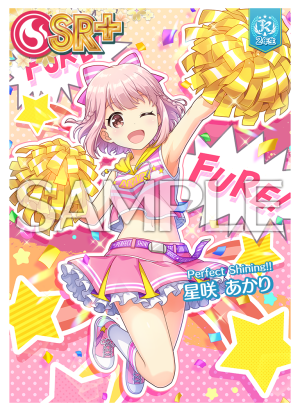
Favorite card: Akari Hoshisaki [Perfect Shining!!]
Happy 5th anniversary to Ongeki!
I’m genuinely grateful to have been given another opportunity to write something like this again, and at the same time, there’s a slight sense of embarrassment—because last time I wrote with the assumption it would be my final contribution, pouring everything into it. So to be writing again now feels a little strange.
For this 5th anniversary, we’ve added “Summer Night Starmine” and “On×Stage!”.
I put a great deal of effort into the chart design as well, so I hope you’ll go to the arcade and give them a try!
Bright MEMORY was something where I pushed everything to its absolute limits at the time, but seeing charts that still manage to make players react out loud and deliver so many impactful moments makes me feel like, “this game still has way more in it than this.”
Now, there’s honestly so much that’s happened that I’m not even sure where to start, but I think there may be people who are curious, so I’ll talk about what I can regarding events since around July last year.
By now, quite a few people may have already pieced it together, but on July 26 last year we added the LUNATIC 18 charts (even looking back now, it still feels almost unreal…), and the chart submission deadline was pushed right up against the absolute limit, essentially forming a near-final package.
Of course, at that point there was basically no planning for what came after, so when the decision was made to continue despite structural changes, everything turned into chaos.
At the time, we had no idea what would happen next, and because of that uncertainty we couldn’t properly communicate anything to users, nor could we deliver content we were fully satisfied with. I remember feeling a persistent sense of regret during that period.
To get things back on track toward March, I—the person on the Ongeki team who could move the most freely—ended up taking on much of the system and design work by trial and error, pushing my brain into overdrive (with occasional small explosions along the way), and what eventually came out of that was the current structure: the resumption of collaboration events and ongoing updates from March onward.
I’ve been making charts, watching everyone else’s charts, and honestly thinking, “this volume is insane… this might actually drive me crazy…”
Among all the changes, one personal design highlight is the reward structure in collaboration events where players can earn a total of 3,000 Chapter 5 jewels (1,000 and 2,000 milestones).
Because I used to primarily play collaboration events myself, I often ended up unable to obtain my favorite DDF cards. So I thought it was time to fix that, and made adjustments so that even while playing collab events, players could still make progress toward strong core Ongeki cards more smoothly.
Whether you’re someone who hasn’t yet obtained DDF/DDA cards, or a veteran who has already fully maxed out their favorite DDA card, I hope this becomes an opportunity to collect other cards as well. They’re all cute—you’ll want them all.
It took quite a while to stabilize things, and I know many people were left uneasy up until the February KoP event. I sincerely apologize for that.
For the time being, I plan to continue at roughly this pace, but one thing I’ve learned recently is that a bit of fluctuation in update content actually makes daily play more enjoyable. So I’m loosely thinking about ways to achieve that balance (plans are not final!).
How long I can continue is honestly uncertain, but as long as I’m here, I feel like there’s still a lot I can do.
As a developer, I want to keep pushing things to their limits, so I hope users will continue playing and supporting the game going forward.
Thank you in advance for your continued support.
★ Recent thoughts on chart creation
I previously mentioned being in a serious chart-making slump last year—but I’ve successfully gotten out of it!
It was really tough at the time, but a VTuber who was also going through a similar slump posted a video about recovering from it. I tried applying their approach, resetting my mindset, and suddenly everything cleared up—it was like, “why was I struggling so much before?”
In the end, it really came down to the importance of “imitation,” and not being ashamed of it.
Of course, copying everything isn’t the point, but trying to create everything from scratch every time is extremely difficult in modern creative work.
Even within imitation, your own style naturally emerges, and that’s what you should value.
Since then, I’ve been doing my best while occasionally being inspired and encouraged by VTubers.
Here are a few charts created during that period of renewed motivation:
◆ HIBANA (LUNATIC)
For the final chorus 16th-note section—you might think “there’s no way that sound is actually there,” and you’d be correct. It basically isn’t.
At a live show I attend every year, HIBANA always plays and the crowd goes wild. During the final chorus, the experienced fans in the front row spin their glow sticks at incredible speed, making the atmosphere even more intense.
The entire front area turns orange and it looks stunning, but the people doing it all look absolutely exhausted. And honestly, spinning at something like BPM 200 16th notes is brutal…
It looked extremely tough, but I thought it might be interesting as a chart concept, so I included it.
The core philosophy of the game is not just to accurately reflect sound, but to do interesting things that match the music. So sometimes it’s fine to go a bit wild.
Also, in the chart itself there are brief rests, but in the live performance you’d have to spin continuously for 8 measures, which is honestly insane.
◆ Rainy Color, Water Color (MASTER)
The CHUNITHM version was well received, so the idea was: how can I express the lyrics through Ongeki?
I think it turned out fairly clear and readable.
The chorus was meant to feel “blue and atmospheric,” but it ended up becoming surprisingly technical.
The intended rules were:
- If flicks appear, keep holding the lever
- If hitting the left wall, use the left button
These were strictly followed, but holding the lever after a flick is surprisingly unintuitive…
This made me realize once again that perfect player guidance is still a long way off.
◆ Flowers, Snow, and Drum’n’Bass. (MASTER)
Until now I had been somewhat conservative with wall-button + tap simultaneous patterns, but I decided it was time to go all-in.
If it says “Ichinose Rizu” and the song is “Flowers, Snow, and Drum’n’Bass,” then basically anything goes.
I also placed configurations I had previously avoided, like same-color holds stacked directly above holds, resulting in a very chaotic chart.
But again… the title says “Flowers, Snow, and Drum’n’Bass.”
For the green vertical patterns at the end of the chorus, try holding with your thumbs while alternating index fingers. In some circles, this is actually a fairly standard technique, so learning it might help.
That said, I think I’ve pretty much exhausted wall + tap simultaneous patterns for now, so I probably won’t be doing more for a while. Sorry to those who struggled with them.
◆ FestA of PandemoniuM (MASTER)
This one was truly, truly difficult.
It ended up being a successful KoP chart, but previous KoP charts had used a lot of “presentation tricks,” and without those tools available, I had to create something satisfying at level 15 that still worked on first play. It was extremely hard.
Other team members were doing things I couldn’t replicate, which helped a lot, but I struggled for about a month unable to find a satisfying direction.
Eventually, I recalled how the bell explosion effect in “Lateral Arc of Radiance” felt almost KoP-level in impact, and used that as a starting point.
With some slightly forced narrative setup, I had Chinatsu-senpai go “Full Power!” and perform an intense drum solo. She really came through.
◆ Imitation: Loud Lounge (MASTER)
This is a chart for a maimai song I deeply loved when I first joined the company.
The concept is very consistent and extremely well-designed—I really love it.
I even had a chance to tell the composer directly, which made me very happy.
Originally I wanted to go much more extreme in Ongeki style from the opening to the final chorus, but I was told it was “too much,” so I reluctantly toned it down.
Honestly, I wanted to recreate the physically demanding intensity you can only really get in maimai.
◆ Regulus (MASTER)
Alongside the previous one, this is another maimai song I love deeply.
The concept was:
“Create a chart that makes me want to replay it repeatedly while still being just barely beyond my comfort zone, helping me improve.”
Looking back, that’s a very selfish design philosophy…
The chorus was also designed to function as practice for a particularly difficult section in “Recollect Lines.”
In hindsight, I think I could’ve made it even harder—it’s an extremely intense section anyway.
The final section includes “I don’t fully understand it, but if you just press things randomly, it somehow works” kind of local difficulty.
Because of system constraints, true localized difficulty is hard to implement, but I think these layered challenges still contribute to player growth.
Thanks to this chart, I managed to reach SSS+ and improve significantly.
My next goal is Rating Master, so I’ll keep pushing forward.
◆ Anti-Gravity Girl (MASTER)
I finally managed to include one of the absolute top-tier V-related songs I love.
However, many people have strong feelings about this track, so I adjusted it very carefully.
That said, about 90% of the work was done by Saturn-CB (you probably know who I mean!), and my role was mostly saying things like “please add a TeA-like bullet pattern here!” and tuning for playability.
Apparently there’s also a hidden element somewhere in the chart, so if you’re interested, try finding and decoding it.
As a side note, due to a series of coincidences in Bright updates, there was a package that unintentionally resembled a “VWW-like” structure but was missing one song, which became a bit of a running joke. After about two years, everything finally aligned properly, and I’m extremely satisfied.
On a personal note, I’ve also started thinking I’d like to do collaborations with V creators I’m currently really into. There are many obstacles to clear, and it may come down to how much I can negotiate with higher-ups… so the next development arc may involve a lot of pleading.
<Revo@LC>
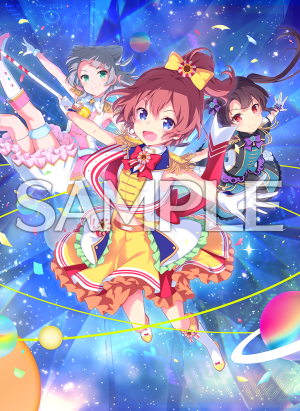
Favorite card: Hinata Chinatsu [FestA of PandemoniuM]
Congratulations on the 5th anniversary of ONGEKI! And thank you very much!
Long time no see. This is Revo@LC.
The featured card is an illustration made specifically for the opponent in the song “FestA of PandemoniuM.”
I think this track became something like the opening act for ONGEKI’s revival at KOP 4th.
The sense of release starting from the chorus feels as if it’s pointing toward new possibilities for ONGEKI going forward, which makes it very emotional.
As for this song, the amazing people who composed it have also uploaded a video of themselves performing it brilliantly, so please be sure to check that out as well!
Well then, I’d like to write a bit here about charts I’ve created myself.
I’ve become quite busy with duties outside of chart creation, so I haven’t been able to make many lately, but I’d still like to talk about them when I can.
If anything I made was able to stir even a small emotional response in those who played it, I feel that would be a great happiness.
【Seventeen Feels】(MASTER)
Hello, this is Revo@LC, leader of Tetrarchia.
This track starts with an uncharacteristically calm opening for Tetrarchia, then bursts open all at once in the chorus. To represent that in chart form, there was really no option other than fully committing to scroll speed changes—that idea was already in my mind from the moment this song was selected.
During the chorus, I intentionally increased the sense of speed by keeping constant movement while continuously hitting eighth notes. As for the outro, it also returns to a quiet ending, and I felt that was part of the song’s identity as well, so deciding the game-length timing was actually quite difficult.
Speaking of Tetrarchia, at the “Re:Stage! Rock’n’Roll PARTY!! ~Re:SHOUT!!~” held on June 10th, Hinata Akari from ONGEKI also appeared as a guest. I was watching nervously from the audience, drenched in sweat, but I was relieved that everyone seemed to enjoy it (I was surprised to see people holding ONGEKI towels). Also, even though it was the first time it was performed in the daytime show, by the night show the entire venue’s clapping was perfectly synchronized, which genuinely moved me.
I hope to continue maintaining a close “super-best-friends” relationship with Re:Stage going forward.
【Time and Space】(MASTER)
The way Sango stands in the center and sings together with the other two is really beautiful, isn’t it? I feel the green line center in ONGEKI suits that perfectly.
That said, since the green-centered layout is already basically the standard ONGEKI chart structure, when recreating the unit using the colorful lane system, I shifted things so that Akane, the unit leader with the color red, would be placed in the center instead.
During the period I was making this chart, I was extremely busy and couldn’t keep up with everything, so I ended up relying heavily on Monokurokku-kun to help finish it.
Also, sorry that the Stella Maris set doesn’t fully connect to the “complete-clear” theme…!
As usual, the song selection for Re:Stage! collaboration tracks is decided after extensive discussions between Green Committee Chair and myself. Though, halfway through, we usually end up saying “we want to include all the songs anyway,” and the discussion stops progressing.
This time it wasn’t intentional, but coincidentally, the unit songs from Re:Stage! collab Part 4 and Part 5 actually line up with the setlist from “PRISM☆LIVE!! 3rd STAGE” (night show), so it ended up being a kind of recreation of that.
【Cosmic Train】(MASTER)
If I had made this normally, it likely would have ended up as a rather unremarkable chart, so I built it around two concepts:
“wall-to-pull flicks (maimai-style slide motions while holding a hold note)” and a five-lane pattern of “red red green blue blue.”
The first draft was extremely unfriendly in terms of playability, so I asked Ichinose Riz-kun, who is good at this kind of gimmick-heavy chart design, to help refine it into its current form.
【Yume Kikyō】(MASTER)
I aimed to build this around 8th-note drum patterns, striking a balance between not being too difficult while still offering solid gameplay depth.
For the chorus, I struggled with how much of the vocal line to follow, but since the same phrase repeats four times, I increased the amount of 8th-note input sections to raise the sense of satisfaction.
Also, the latter half can serve as practice for 16th-note patterns across six lanes.
【Perfect Shining!!】(LUNATIC)
These are the MASTER chart released during location testing and the Re:MASTER chart released for the 4th anniversary.
I feel these two charts really reflect the four-year gap between them, and they are both deeply meaningful to me as a result. It is a song I truly love.
As for the extremely intense Bell section at the end of the Re:MASTER chart, it is actually a near-direct conversion of the late-stage slow bullet-hell pattern from “Ongeki・Shin,” simply turned into Bell notes.
If avoiding bullets is difficult, then surely collecting them should be difficult too, right?
◆ Summary
It has already been about one year since “Memories of O.N.G.E.K.I.” was released.
At the time, I intended to pack in enough content that it wouldn’t be fully mastered immediately, but looking back after a year, how has it been?
Thankfully, over this past year, many players have reached unexpectedly high levels of character intimacy and user levels. The number of clearers for “Ongeki・Shin,” which I expected only a few people to clear, has exceeded 100. Multiple players have also obtained the “Ongeki” title, which is likely the ultimate technical goal of the game, along with many other achievements.
All of these far exceeded our team’s expectations, and I am deeply moved every time I look at the records. I also sincerely thank everyone who continues to work hard in ranking events, technical challenges, monthly BP rankings, and more.
As for myself, I managed to reach “Rating Master” this year, but I still cannot even come close to “Recollect Lines” or “Ongeki・Shin,” and I’m also still far from “Sousei” in BP. There is still so much left for me to do.
At the same time, there may also be people who stepped away from ONGEKI over the past year.
I hope that when such people feel like returning to ONGEKI again someday, we can continue to provide an environment where they are able to come back easily.
Rather than setting overly distant goals that might become exhausting, I hope everyone can progress—or not progress—at their own pace, and continue engaging with ONGEKI for a long time to come.
I look forward to meeting you all again someday.
<Greenery Committee Chair>
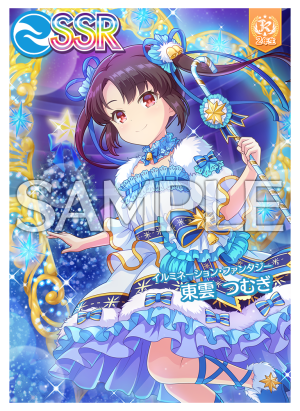
Favorite card: Shinonome Tsumugi [Illumination Fantasy]
Hello. This is Ryokuka Iinchou.
It has been a year since the last newsletter, and some of you might be thinking, “You’re still around?”
I’ll skip the background details, but I’m still involved in things like the official website, tournaments, and merchandise.
We also announced the second body pillow cover today. Let’s aim for the 200th release—thank you for your support.
There may be even more merchandise coming! Stay tuned for further updates.
By the way, I’m actually the one who’s missed the most deadlines! Really, I’m sorry!
I briefly considered writing something that could sound like an excuse, since there were some strong requests for it from certain people, but I decided against it because I tend to prefer writing positive stories.
So, here are the highlights from the past year.
KING of Performai The 4th
During the event KING of Performai The 4th, my role was to stay near the equipment area and handle things like monitoring the broadcast, checking score accuracy, maintaining chat moderation, posting breaking announcements on Twitter, and occasionally running out to the arcade cabinets.
This time, I ran over to the cabinets twice, and also did a thorough recheck of the machines during the maimai DX finals.
One of my major responsibilities was instructing when to adjust the volume for the final round song presentation.
That final presentation behaves a bit differently from other parts: the audio volume depends on the headset volume setting.
In other words, not only is the volume different from other segments, but it also changes depending on who is sitting at the final cabinet.
Because of that, it was necessary to precisely control when the volume was raised or lowered.
If the timing was even slightly off, the “babyuun” sound effect in the presentation could become explosively loud, or the same effect after the match on the opponent screen could end up too loud as well, making the timing extremely tricky.
After it was all over, I rewatched the archive and finally felt relieved.
It was only about 30 seconds of actual work, but it was also the moment I sweated the most.
Going forward, I intend to keep improving the quality of tournament operations. Thank you as always.
In the previous tournament, the track “POTENTIAL” had a very distinctive debut. I liked the song a lot, so I was excited to make a MASTER chart for it.
However, it didn’t feel cool enough, so Roshe made the chorus section significantly cooler, and senior colleague Monokurokku improved the bullet-hell section in the slow part.
We also had the overall difficulty tuned down, but the accelerating section was actually made harder, which honestly made me laugh out loud.
The final four measures are a non-negotiable highlight, so I hope you’ll play them with full, stomping intensity.
April Fools “Ichi-Geki!” Event
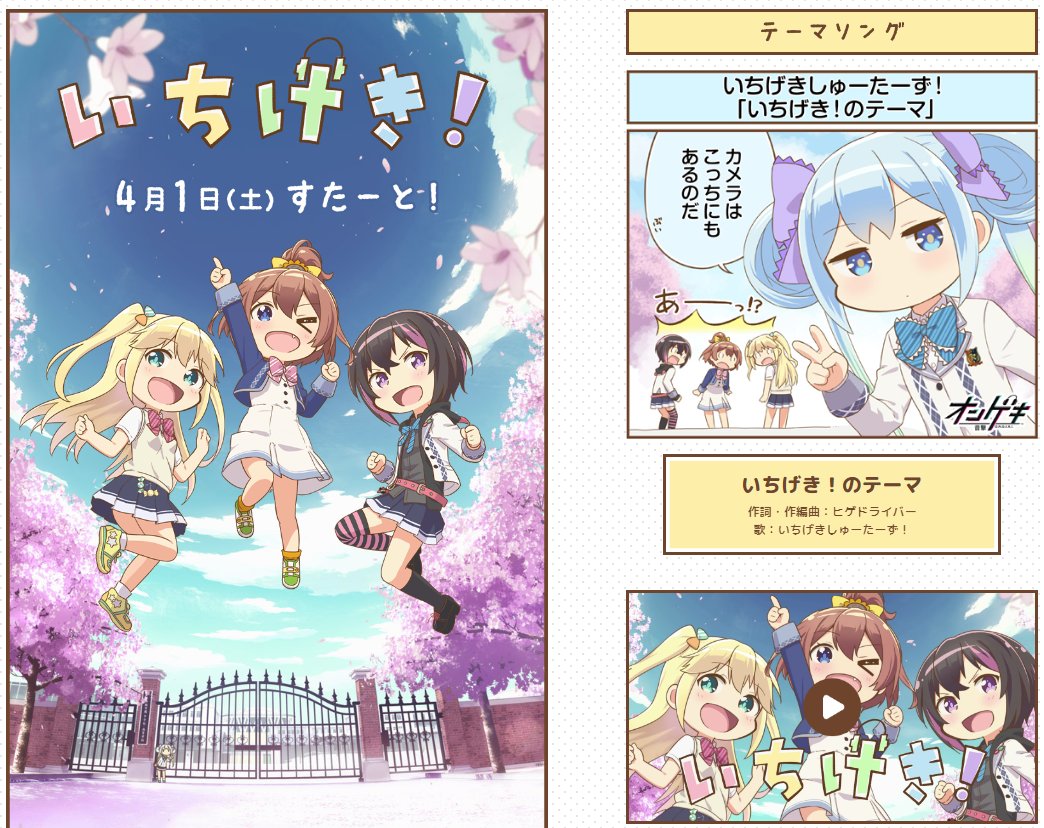
April Fools’ Day ideas sometimes need to be decided even before the previous year’s April Fools’ event has taken place.
Because April Fools’ initiatives carry the contradiction of “lying” while also being “implemented,” we need to prepare things that are normally unlikely to happen, yet still feasible to implement in-game, and above all, things that can “go viral” (extremely, super, ultra important).
This is something the lineup planners struggle with every year, but this time we quickly settled on the “Ichi-Geki!” idea, which we had been nurturing for a while.
Of course, the most important aspect is a visually clear transformation, but for April Fools events in Ongeki, another key point is that we can actually print interesting cards. If we can print “Ichi-Geki” cards too, the impact would be huge—and honestly, I want them myself. I’m also secretly planning to turn them into merchandise whenever possible.
Now that that’s decided, it’s time for the main visual. We asked Elrant, who has always illustrated “Ichi-Geki,” to create a best-in-class illustration based on the original key visual.
For the music jacket, we wanted to give it a duality compared to the key visual, so after some thought we made Arisu into a peace sign. V.
For the official website, when I said “please make it like this based on the key visual,” the web designer added Mia taking photos, and I ended up applauding at my desk. Every year I’m grateful for how they exceed expectations.
For the cards obtained this time, I selected particularly distinctive faces and gag-worthy ones myself. I’m sure many of you also have “I want this printed as an Ichi-Geki card” favorites, right? I certainly do. I’m hoping to make as many of those happen as possible.
Since we’re here, please share your own “I want this printed as an Ichi-Geki card” ideas using the hashtag
#オンゲキでカード化希望のいちげきを挙げる
Regarding the song “Ichi-Geki! no Theme,” it hardly needs explanation. We’re extremely grateful to Hige Driver for providing such an incredible theme.
There is also a small trick in the solo version—please check the CD if you’re interested.
As for the chart design, I started by placing HEADLINER at the end, then inserted the intro of GAME IS LIFE (LUNATIC) into the chorus, then added Gagao Gymnastics, and so on. The result is a rather unusual chart where, despite being a vocal song, very little of the actual vocal is directly mapped.
It incorporates many “Hige Driver-style” chart elements, and in that sense, it became a kind of “greatest hits” arrangement. However, I personally consider the chart’s true 99% to be the “face wash (Mincho font)” at the beginning and the moment when the Ichi-Geki logo stops at the end—so I hope players enjoy it with that in mind.
The video for “Ichi-Geki! no Theme” was also packed with everything we could possibly fit in after asking the designer, “Please just put as much Ichi-Geki as you can!” Looking back, it really brings back memories of 200+ iterations. I’m deeply grateful.
Ichi-Geki! will continue to depict the everyday lives of the Shooters going forward. I’ll keep struggling with the lack of a proper straight man and constantly being thrown into chaotic roles, while continuing to come up with new ideas. Since Elrant keeps delivering insanely cool compositions every time, my contribution is probably about 0.1%, but I’ll keep at it.
Ichi-Geki! is planned to update roughly every Thursday during weeks when Ongeki doesn’t have a main update. Please look forward to it.
Yokohama Bay Hall
At Yokohama Bay Hall, as we entered the latter half of the daytime show and MC began, my nerves—somewhere in the audience—peaked.
How would the Rememberers react? Would they welcome it warmly?
In the end, there was absolutely no need to worry. Everyone stood up, and I was deeply moved.
During the night show, I even got to wave a towel, which was very satisfying. In the daytime show I played along with call-and-response from the surroundings, but in the night show I got too excited and shouted “one more time!” on my own—which was probably a mistake. If there is a next time, I’ll rely on everyone for that “one more time!”
It had been a long time since I felt such intensity in a live venue. Like tournaments, live performances are very important spaces where collective energy becomes visible. I really want to see even more of that energy expressed.
Ah, at the December live announcement of “We Play the Four Seasons!!” I was sitting somewhere in the middle rows, but I had to refrain from reacting too strongly to avoid being noticed.
As for the LUNATIC chart, about 99% of its creation motivation was “I really wanted to hit walls with dotted rhythms.” I adjusted everything else around that desire, which ended up making it fairly difficult.
What I originally wanted most was the wall spam during the latter part of the C section, synced with “chotchotchotcho wait a second (doko doko doko doko)”—but that was just something I imagined while designing the chart in my head. Apologies.
Now more people within the team understand the power of Rizst, and my current role is basically to play finished Rizst charts, give a thumbs-up, and leave.
As fellow “zubutomo,” I look forward to continuing working together.
I still need to clear “Instinctive Survivor” and “Saikō no Entertainment!!,” so I’ll be working on those starting today.
4th Anniversary LUNATIC Charts
Since I didn’t get a chance to write about them earlier:
- GAME IS LIFE (LUNATIC)
I tried to keep this relatively straightforward and modern. The original MASTER chart has some sudden dual-hand patterns that become more fun when revisited now.
What I really wanted was the slightly choreography-like section in the intro. I had heard from choreographer Sho that parts of the live dance were inspired by the MASTER chart, so this was a kind of return gesture. - GODLINESS (LUNATIC)
The goal was to create Zellen Wanderung-style staircase patterns and force varied keyboard work using holds combined with 8th/16th note interplay.
I leaned heavily into difficulty, intentionally including patterns I personally struggle with.
Since the original was designed as one of the hardest vocal tracks, I wanted the LUNATIC version to remain the strongest in the vocal category. - Transcend Lights (LUNATIC)
This one was my own work. When the PV was released, some people commented that it might get a difficult chart, which surprised me, and made me want to actually pursue that direction.
The goal was mixed rhythm layering and PV recreation. I also inserted patterns inspired by a level 44 chart from another rhythm game I really like—especially in the intro and outro. It’s a fairly rare BPM range, and I wish there were about 30 more songs like this.
I intend to stay involved enough that I can keep writing texts of this length in the future.
And if everyone continues to support us, there’s a good chance more things will happen that I’ll be able to write about here again.
Thank you, as always.
<Amaryllis>
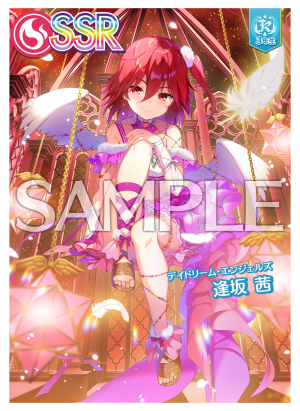
Favorite card: Akane Ousaka [Daydream Angels]
Hello to all Ongeki players. This is Amaryllis.
It’s hard to believe it, but a full year has already passed since the finale of Memories of O.N.G.E.K.I.
I can’t properly put into words just how grateful I feel that we’ve reached the 5th anniversary in this way.
Thank you, as always, from the bottom of my heart.
This year as well, I’d like to talk about the chart that left the strongest impression on me during Ongeki’s fifth year.
◆ Sunrise Platform (MASTER)
Among the most emotional songs in Ongeki, this is one of the absolute most emotional.
When creating this chart, the biggest challenge was how to express the “sunrise station platform.”
I remember going back and forth between the cabinet while discussing ideas with Monokurokku-senpai, debating endlessly what should be prioritized: the “platform feel,” the “sunrise atmosphere,” or the “two people waiting for a tomorrow that will never come” feeling.
In the end, we settled on having the outer field lanes gradually brighten like a sunrise sky, and I’m quite fond of how those shifting colors evoke emotion.
When making charts for narrative-driven songs, one of the hardest questions is how much of the story should be incorporated into the chart itself.
Ongeki charts have extremely high expressive capability, so in theory you could even embed every lyric into gameplay. However, to maintain game balance, it’s important to identify the key lyrical moments and incorporate only those while restraining the rest.
The tricky part is that as you repeatedly listen to the song, every lyric starts to feel important, and it becomes harder to judge what should be emphasized.
Monokurokku-senpai, who oversees chart quality, is incredibly reliable in moments like this, and I’m very grateful for that.
I hope you’ll play it while imagining the scenery described in the lyrics.
◆ GranFatalité (LUNATIC)
◆ Rule the World!! (LUNATIC)
Among my favorite character songs in Ongeki, these are the ones I love the most.
(It is acceptable for “the best” to consist of two songs.)
Whenever additional charts, remixes, or cross-game versions are released, I get extremely excited about what kind of chart they will become. Don’t you? Personally, as a chart enthusiast, I get very excited.
From the perspective of chart creation, the challenge is to firmly establish a concept, respect the original chart, and still create something that stands on its own without making people think “the original is better anyway.” That’s quite a high bar.
At the same time, it’s also a fun challenge—trying not to betray the excitement I feel as a player myself.
In that sense, working on the 17 (+1) LUNATIC charts was especially exciting for me. The concept of adding higher-difficulty versions to early charts was very clear, which made things easier to approach.
The one miscalculation, however, was that the two songs I chose simply because I loved them—“GranFatalité” and “Rule the World!!”—ended up being close in BPM and both featured triplet guitar solos.
Normally I try to keep BPM and genres somewhat varied across the songs I work on, so I had to be careful about unintentional overlap in ideas between my own charts.
It was also a fresh challenge to create higher-difficulty charts for my own earlier work.
Both songs retain elements of the original charts, such as note patterns and hit structures, so I hope you’ll compare them while playing MASTER.
◆ MonDai Night Ripper! (MASTER)
Among my favorite songs in Ongeki, this is one of the absolute favorites.
Fortunately, we were able to run a revival collaboration event again, and alongside the song itself, we also added Kyomshi costumes, Devil Natori cards, and plates.
I may be the one who was happiest about this revival, but I sincerely hope all Ongeki players enjoyed it as well.
I first heard MonDai Night Ripper! on March 7th, 2022, at CINE8 in Kawasaki CINECITTA’. I remember it vividly. As I had been a fan of sasakure.UK for around 18 years, the moment the intro started I basically lost consciousness, turned into sand, and became a wind blowing through Kawasaki.
The more you listen, the more you discover the expressive variety in the vocals, and that’s what makes it so enjoyable. The synergy between Natori’s incredible vocal versatility and sasakure’s style—constantly shifting timbres and a theme of traveling the world—is truly remarkable.
(And speaking of sasakure and Natori, the Halloween cover of Tondemo Wonders by Natori and Yahiro was also amazing…)
Due to scheduling, I ended up creating this chart right after this year’s Natori birthday event.
I originally planned to enter the project with peak motivation, but that event was so overwhelming that instead I found myself working under the tension of worrying whether I might leave an awkward trace on the world she had built.
The A-melody was designed as a lively scene filled with “Sana Channel Characters.”
The B-melody shifts playfully like traveling the world, constantly changing visual and gameplay elements.
Small hidden jokes before the chorus are subtle enough that only some players will notice them.
The chorus incorporates live choreography, with left 4-beat patterns followed by right-left-right movement.
The total number of bells is 316. These parts came together smoothly as planned.
The part I struggled with most was the pre-final chorus “drop” section.
In the end, it settled into a progression from a slightly lonely gray palette to the vivid signature color associated with Natori, and even though I made it myself, I think it turned out quite emotional.
If you became interested in this song through Ongeki, I highly recommend checking out the official music video on YouTube as well as the archive of the first live reveal event, Sana no Bakutan. – Mega Happy Show –
◆ Azucar (MASTER)
Among the most fun songs in Ongeki, this is one of the absolute most fun.
I created this chart under the name “respect for Takanashi-sensei,” because I really love their charts.
Their signature style in Ongeki is focusing on the core question of “do you hit with both hands or one hand?” and “isn’t smashing keys just fun?”—and maximizing that experience.
The intro is a straightforward three-lane pattern inspired by Takanashi-sensei.
Midway, it includes my own original idea (a bullet-avoidance section that transforms bullets into taps).
From the chorus, it shifts into a five-lane keyboard-style section in Takanashi-sensei’s style.
After the field expands, elements from earlier sections combine, such as bells turning into taps.
Overall, it was structured as a playful (and somewhat self-inserted) “Amaryllis vs Takanashi-sensei” composition.
While creating it, I kept imagining Takanashi-sensei saying, “Yeah, for this song, this is definitely the way to do it!”
I was also fortunate to receive positive feedback from Takanashi-sensei after they played the released chart, which made me personally very satisfied.
I hope you’ll try it alongside other charts created by Takanashi-sensei as well.
<Miso Katsu Samurai>
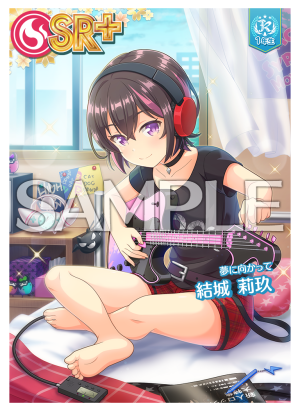
Featured card: Riku Yuki[Toward the Dream]
It’s been a while.
This is Miso Katsu Samurai.
As I also mentioned in the CHUNITHM section, I’ve been part of the maimai team for about a year now.
At my desk, Amaryllis-senpai and a new recruit sit on either side of me.
Amaryllis-senpai is always groaning, “I don’t have time to make charts!!!” and looks like she’s having a really rough time.
The new guy seems to be happily tapping away at charts all day, and I often hear him humming.
I can even hear it through my headphones, so maybe take it down a notch.
I tend to talk to myself a lot too, so I should watch that as well.
There’s a lot I want to talk about regarding recent developments, but first I’ll go over the charts I’ve made over the past year.
I usually get told, “this is way too long, idiot,” so this time my goal is five lines per song.
Let’s go.
◆ Tobi Dase! TO THE COSMIC!! (MASTER)
In the second loop of the first chorus, I tried placing a rhythm that screams “this is happy hardcore,” and it turns out CHUNITHM also used a similar sound interpretation, which made me think, “yeah, that makes sense.”
Maybe Redarrow and I were raised in similar musical environments.
◆ P! P! P! P! GAAOO!! (LUNATIC)
This is one of those songs where I can confidently say, “this is the reason I started playing ONGEKI.”
It hits my generation really hard, but I think a lot of ONGEKI players are fans of Tom-H@ck as well.
Since the MASTER chart was from the original version and relatively restrained compared to the sound, I went all-in and made this a more chaotic, upgraded version.
For the final section, the rhythm is actually identical to MASTER, but just changing the visual presentation makes it dramatically harder.
Five years ago, Riku was singing “I’ll stand on that stage someday,” so I also worked hard on the illustration to bring her there.
Of course, the spotlight is pink.
She really made it.
◆ SWEET SHAKE!! (LUNATIC)
I’m not sure how widely this will be understood, but this chart explores a new way of using the color lanes.
Recently while playing rhythm games on mobile, I felt it’s not great when it’s visually unclear whether something is swung or not, so I think this ONGEKI solution worked quite well.
By the way, “5:3 swing style” refers to a state offset by a 64th note from a flat grid. For example, PinqPiq (xovevox Remix) uses a 96th-note offset.
A 2:1 swing tends to feel heavy, so I personally think something like 5:3 is the sweet spot for subtle swing. What do you think?
◆ Doubutsu☆Paradise (LUNATIC)
I wanted to draw cute animals, but unlike CHUNITHM slides, ONGEKI holds can’t vary in thickness and can only extend upward from the bottom (and slightly diagonal downward isn’t really possible either), so drawing with holds was really difficult.
Still, I pushed through because I really wanted to do it.
The chart itself is based on the MASTER version, with added quintuplets I really wanted to include.
Quintuplets in ONGEKI feel pretty fresh. (Though they’re rare in most rhythm games anyway.)
◆ Paradisoda (MASTER)
This is one of my favorites.
It’s basically just scratching mapped directly to the sound in the chorus, but it feels incredibly satisfying in ONGEKI.
No bad judgments is beautiful.
Splitting flicks left and right is kind of a fake double-play style idea.
◆ Ring (MASTER)
The first thing I always do when making a chart is stare at the lyrics, but I didn’t really understand them this time, so I read the character story instead and ended up crying.
So I thought, I have to express something in the chart.
There’s a little hidden element in the first chorus.
Did you notice it?
◆ Sugar Song and Bitter Step (LUNATIC)
Another favorite of mine.
This song appears in many rhythm games, and I basically gathered the “this is the rhythm that defines this phrase” interpretations of the track.
If you’re someone who loves the song but feels the MASTER chart isn’t enough, I hope you enjoy this.
◆ FestivaLight (MASTER)
Since the song is short, the theme might be hard to grasp, but it revolves around finger twister patterns and unsynchronized lever inputs.
This idea was later expanded in the chorus of FestA of Pandemonium, which I’m pretty happy with.
Also, the “people passing by laughing together” section somehow got called “horror” by others. Not sure why.
◆ Sora no Tonari (MASTER)
This was made in a panic three days before the deadline, with no one assigned to it yet.
I thought I was going to die.
I tried to express the chaos of space through the chart.
The countdown section is basically half a homage to Ongeki’s own patterns, but it cleverly exploits projectile targeting behavior.
Some people even noticed the details, which is impressive.
◆ Shukusei Shinpan (MASTER)
Personally, I don’t usually think about 5-key or 4-key patterns when playing CHUNITHM charts, but this song is known for 5-key finger patterns, so I designed it as a tough 5-lane chart and also as an entry-level level 15.
When lanes are used randomly, it’s not interesting, but reading the flow while keeping up at just the right speed is actually quite fun.
“Final Umpire” refers to the idea of a final judgment across the three GekichuMai games, nothing more.
Aim for 303.
◆ C & B (MASTER)
I really love this song.
It has a very stylish sound, so I wanted the chart to feel stylish too, but I overdid it and got told it was “too chaotic and incomprehensible.”
After many adjustments, I hope it ended up in a good place.
◆ Cat Rubbing (MASTER)
“Maybe today they’ll gently pet me?” and then after that, just finish it off with your right hand.
But I do prefer kind people, of course.
◆ Spiral Galaxy Sinfonietta (MASTER)
My favorite song in maimai.
At this point, most CHUNITHM and maimai songs coming in were basically the preferences of me or Monoclock-senpai.
I think I basically forced it in by arguing, “we’re the ones making most of the charts anyway, so let us pick the songs we like at least!” while protesting Revo-senpai’s lineup.
If you like modern classical music in the broad sense, this should hit hard.
I especially love not only the wind harmonies but also the rich percussion textures, since Yamamoto Mao is a percussionist.
There were so many sounds I wanted to pick up that the chart became pretty difficult, but I think it captures a strong sense of performance even beyond just taps.
Unlike real instrumentalists who stick to one role, rhythm game charts can cherry-pick the best parts, which is great.
◆ Goodbye Declaration (MASTER)
At the end, if you cross your arms and flick with your left hand, then tilt your body slightly left and bring your hand up, you’re supposed to strike that iconic pose.
But I’m the only one doing it in arcades, so it’s kind of embarrassing.
Everyone should try it.
◆ TECHNO POLIS 2085 (MASTER)
I tried to reinterpret CHUNITHM’s genius chart in ONGEKI’s style.
I really respect people who can create something from nothing.
I love charts that require thinking while playing, but over the past couple of years I’ve also been reflecting on how some players drop off due to readability issues and complexity.
Balancing difficulty and accessibility is always hard.
Most people reading this are probably already deep into ONGEKI and a bit bored of “normal” charts, but for beginners, newer MASTER charts can feel harder to read and less intuitive compared to older ones.
This chart, and “Kiri no Shosai,” are definitely aimed at people who already want more complexity, so it’s not something I’d recommend to someone just starting level 14.
◆ Vampire (MASTER)
Another favorite of mine.
With fewer chart designers recently, I ended up making this while repeating “I am Usagi Laundry… I am Usagi Laundry…”
I think I managed to balance motion and visual readability well, similar to that style.
◆ Starry Colors (MASTER)
I noticed there aren’t many 5-lane charts at level 14, so I made this as practice for people struggling with Shukusei Shinpan.
The chorus rhythm was heavily inspired by maimai charts.
I’m always impressed by Roche-senpai’s unique sense.
The final 32nd notes do have a bit of malice in them, if I’m honest.
But it only appears three times, and half of it lights up, so it’s kind.
◆ Sil·V·President (LUNATIC)
Another favorite of mine, part 4.
This feels like pure ONGEKI.
The “Where are you now, I found you” phrase is a bit of a one-off gimmick, but I quite like it.
Even for pop songs, I think it’s fun to go all-out like this when possible.
◆ Hainuwele (MASTER)
To be honest, this was a slightly uncertain chart for me.
Since it’s a very “pure rhythm game song,” I now think I could have gone even more extreme like Love & Justice while keeping the middle gimmicks.
It’s hard to know how far “ONGEKI-ness” should be pushed.
People have criticized things like “don’t use 6 lanes,” “don’t use random streams,” “don’t rely on finger patterns,” etc., but in the end, anything difficult will get complaints anyway.
So I decided to return to basics: make charts that match the music and do what I want to do in ONGEKI.
Technical songs get technical charts, rhythm game songs get rhythm game charts. That’s my philosophy.
The mid-section gimmick rush is something I actually like a lot.
The fake crossovers that turn out not to be crossovers are fun.
◆ Phony (MASTER)
A chart where lies eventually wrap around and you become the lie yourself.
Try not to lose yourself.
◆ FestA of Pandemonium (MASTER)
From “Chinatsu full power!!!” onward, it’s Monoclock.
Before that, it’s me.
This was my first time working on a KoP finals chart, along with Monoclock-senpai.
I initially started pushing ahead confidently, but eventually ran out of ideas due to the density and drum fills, so I handed it over mid-way with “TASUKETE” and a “dying lane” left in the editor.
It took about two months from start to finish, but I’m satisfied that it became a fittingly flashy chart.
We used stem files (separated instrument tracks), which allowed us to carefully map every part of the song.
Thanks again for that.
I think I’m probably the only ONGEKI staff member who considers theoretical max difficulty while charting.
At the end I even “brightened” the last 20 minutes out of goodwill… though maybe it wasn’t necessary.
◆ Declaration Sensation (MASTER)
This is another favorite of mine, number 5.
Constantly changing patterns and visuals usually causes discomfort, but here it came together nicely with the song’s vibe.
I aimed for something enjoyable for both ONGEKI and Re:Stage players, so it’s a bit challenging but worth trying.
◆ Let you DIVE! (MASTER)
The “everything WACCA” section apparently made someone think the arcade cabinet was malfunctioning and they were about to call a staff member.
This is a workplace, you know.
◆ PARALLEL★PRISM (MASTER)
This was a very fun song to chart.
It layers sampled vocals over a repeating melody, so I leaned into the samples rather than repeating structure, which created good contrast.
Since this was a long-awaited P*Light track in ONGEKI, I made it slightly more intense than usual.
By the way, charts that end with fast 16th-note bursts are always tricky.
If you use taps in 6 lanes, the climax can feel visually flat.
If you use flick spam, difficulty scaling can feel off.
But you also can’t reduce motion too much.
It’s always a headache.
I recently made a similar chart, and I’m a bit worried about how the ending will be received.
◆ Starlight★Limited (MASTER)
This was a commissioned instrumental track, and I was able to request it from Katagiri Tsugumi, whom I deeply admire.
Everything happened extremely quickly, from commission to release, but I’m very grateful.
Since Katagiri comes from a background involving large, colorful nine-button layouts, I kept that in mind a bit, but I think using ONGEKI’s standard six lanes to their fullest created something unique and still very fitting for ONGEKI.
◆ Starry Orbit, To You at the End of the Journey. (MASTER)
I recently moved to the maimai team and have been listening to a lot of songs—Sky Street region really has too many good tracks.
I tried to balance the note count, but I ended up short by about 150 notes and had to painfully add more.
ONGEKI allows overlapping flicks, so adjustments of ±20 notes are easy, but this one was rough.
I think I managed to draw the shooting stars nicely.
The experience I built up since Rin’ne Tensei really helped.
◆ Villain (MASTER)
Another favorite of mine, number 6.
This is a chart dedicated to all noble villains.
Interpretations may vary, but in the end it expresses confusion of identity and collapse of the self.
If you mess up the hold releases, I might just smile.
Lately, news like this keeps showing up every day and it’s exhausting.
Things that shouldn’t be laughed at, things that shouldn’t be ignored, things that clearly aren’t right even from the perspective of those involved.
Sometimes people just want to be left alone.
◆ Snow Colored Score (MASTER)
There is a rendering limit for lanes, and when I tried to make too much snow fall, it caused slowdown, so I had to cut it in half.
I hope it still came across as impactful for those it resonates with.
◆ Invisible Frenzy (MASTER)
Like DRAGONLADY, I personally struggle with fast streams, so I made this myself because I thought, “if I don’t do it, it’ll become something terrifying.”
The mid-speed section was tricky—I wanted a gimmick but couldn’t find the right idea, so I asked Monoclock-senpai for help, and they delivered something great.
Fast songs often get dominated by the image of streams, but I tried to prioritize the feeling of performance and satisfaction when playing cleanly.
Please give it a try.
◆ Summer Twilight Star Mine (MASTER)
Congratulations on the 5th anniversary.
I tried to recreate the firework display that Amaryllis-senpai couldn’t launch in Summer Colors Fireworks.
Well… bullets didn’t work this time either.
I hope we can celebrate again next year.
◆ ??????? (LUNATIC)
I’m not sure when I’ll be able to talk about this chart, so I’ll apologize in advance.
Sorry about that.
Please try it completely blind if possible.
I suspect about 90% of people will never touch it again, but sometimes that’s fine.
Green Committee-senpai reached around 1,005,000 points after work while clicking their tongue the whole time.
Please don’t click your tongue.
An “ABFBND” title is also prepared, so please check it out.
That’s it for the chart discussion.
From here, I’ll talk a little about my recent situation.
It might get a bit serious.
As mentioned at the beginning, I’m currently on the maimai team, helping with maimai DX NET and general operations while also supporting ONGEKI development and charting.
Mellonpop, a former ONGEKI programmer, is in a similar position, supporting ONGEKI while working on new maimai projects, and honestly they’re incredible at it.
I often joke about wishing I could split into three people—there’s so much I’d like to delegate if that were possible.
I wouldn’t say I’m overloaded with work, but recently I’ve been feeling mentally unwell more often and have been a bit down.
In the past, I would look at user feedback on social media and use it to improve or reflect, but recently I can only really respond with “I’m sorry,” and I find myself holding things in more.
Of course, over the past year there have been many criticisms of ONGEKI’s management and charts (or rather, staffing imbalance), and there are many things we as a team need to accept.
However, there are also limitations due to circumstances beyond our control.
As obvious as it sounds, a game exists because of its players, its staff, and the higher-level structures and funding that support it.
Without players, the game cannot continue, but without staff and organizational support, it also cannot exist.
And every current member is someone essential who cannot simply be replaced.
Every small comment on social media reaches staff more deeply than most people might imagine.
With the internet today, criticism reaches developers easily, and unfortunately many people are getting hurt as a result.
Behind every critique, there is a human being.
I’m not saying all criticism is bad, but I hope something in this message gives you a moment to think about that.
In this situation, I want both sides to be able to continue engaging with the game in a healthier way.
I chose to write this from my own position, since people higher up likely can’t speak freely about these things.
Even so, I’m deeply grateful to everyone who continues to play ONGEKI under these conditions.
I want to leave behind both gratitude and apologies here, and keep moving forward step by step from today.
Well then, goodbye.
〈Roche @ Penguin〉
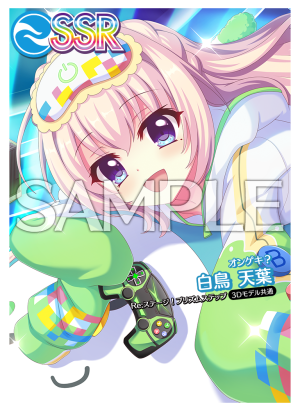
Favorite card: Shiratori Amenoha [Ongeki?]
Hello, this is Roche @ Penguin.
I’m the “inside” of the penguin who appears on official livestreams and similar broadcasts.
The Amenoha card I recommended as my favorite is truly wonderful.
Thank you so much for fully embodying Koboshi.
As a side note, my own Koboshi DDA has finally reached ★2.
Friendship level has exceeded 700, and I’m hoping to speed things up so I can reach 1000 next year.
maimai is already 11 years old, CHUNITHM is 8 years old, and Ongeki is already 5 years old as well!
All of them have July birthdays, so GekichuMai must be incredibly busy.
I recently wrote a lot in the CHUNITHM staff comments as well,
and now here we are again with another Ongeki chart team newsletter in quick succession.
I’ve mainly been involved with Ongeki through chart design all this time as well.
Let me introduce some of the charts I’ve worked on recently.
◆ YO-KAI Disco 【MASTER】
From the second half onward, it’s as if the notes have been cursed, and enemy bullets begin piling up heavily.
For the section where you open a gap on the side of the field to collect bells,
please imagine it as picking up items from an alleyway beside the field in the original game.
◆ TECHNOPOLIS 2085 【EXPERT】
When you think of this song, you think of an idiosyncratic chart, so
I aimed for a strongly quirky EXPERT chart as well—but I may have made it too strong.
Please do your best to overcome the difficult hold-note interactions.
◆ hainuwele 【EXPERT】
For an EXPERT chart, there are some very fast and long vertical repeated notes, but I’ve reduced the overall information density,
so if you’re confident in your skill, try seeing if you can power through it one-handed (not recommended).
I attempted an overly ambitious theme of giving it a “myth of food origin” feeling, matching the title,
but unsurprisingly I gave up partway through because it was impossible—though you might still sense fragments of that idea somewhere.
◆ Kimi to Infinity -2021- 【MASTER】
The infinity symbol appears at the “Infinity” section, also matching the choreography.
The lanes are drawn continuously in colors representing the two characters,
so try playing it while bouncing along in sync with the lane movements.
The chart team around me said, “The flower is way too big lol,” but I released it as-is.
◆ Anti-Gravity Girl 【EXPERT】
In order to match the song’s tone, I heavily used speed changes—something rarely done in EXPERT charts.
With advice from Monochrome Clock, who is very knowledgeable about VTubers,
and from Gekka Iinchou, who is deeply passionate about TAKU INOUE,
I also incorporated various elements from the music video throughout the chart.
I wanted to preserve the long notes while also maintaining note density,
so the difficulty ended up a bit high—but I wonder how it feels to play.
◆ Tsukikage no Traumerei 【EXPERT】
Inspired by Re:Stage! Prism Step, I included sections where lane positions dramatically shift.
In the latter half, along with the three colored lanes representing TROISANGES,
I hope you can play while feeling as if you’re dancing together with them.
◆ Lag Train 【MASTER】
This is a full MV-sync chart. Especially in the sections surrounded by lane blocks,
the player character appears to be teleporting instantaneously,
so I think I was able to get quite close to the feel of the music video.
Please try playing it while recalling the MV.
Last year, we were in a situation where we couldn’t even guarantee what the future would hold,
but thankfully it seems Ongeki will be able to continue going forward.
I am truly grateful to everyone who always enjoys the game.
From the inside, I keep throwing out requests like “I want that song added,”
“please implement this kind of feature,”
“I want a Koboshi pillow,” or “increase the budget,” and so on without restraint,
but I’m constantly reminded, “it’s not that simple.”
And having seen the situation firsthand, I fully understand how difficult it is.
Still, I refuse to give up and keep trying to push things from within whenever I can.
To Koha D, Tagawa D, and all the programmers and designers—
I’m really sorry for always being such a troublesome presence. Please forgive me (not really reflecting)
More than anything, we need your support.
It makes me happiest when you play a lot.
When you post fun things on social media, draw fan art, or share feedback—everything reaches us and becomes strength. Thank you.
As both a creator and a fellow player, I want to keep walking alongside all of you.
Let’s continue building Ongeki’s history together.
<-100>
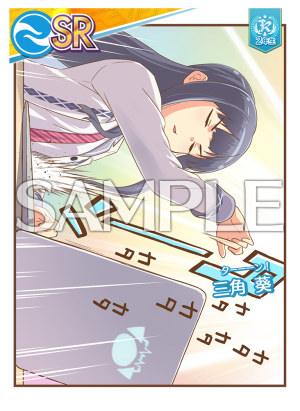
Favorite card: Aoi Misumi [Taaaaan!]
Helloooo, this is Chart Unit No. -100. Long time no see. I’m writing this while absolutely blowing past the deadline. Sorry, Gekka Iinchou.
I’ll leave a few small notes here that haven’t gotten any comments yet.
- Apollo No. XX refers to the name of the overall program itself. So what about “shuttle”?
- Morse code has been embedded.
- The PV recreation was actually worked on quite a bit.
- Natori is definitely watching closely.
- The lunar surface recreation was also put a lot of effort into.
- The note placement in the final section was also carefully worked on. It doesn’t seem to be strictly On Rhythm.
- Oh right, the two-stage rocket section was seriously pushed hard. It’s basically what happens when you fully test the limits of what a chart can do.